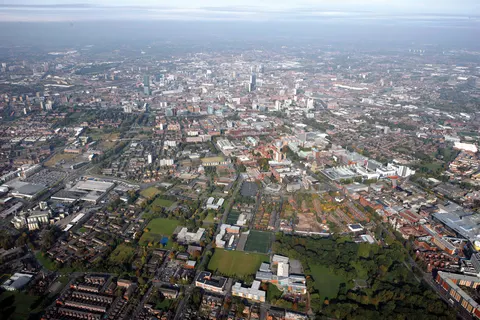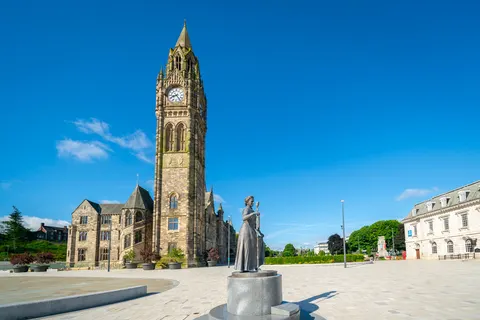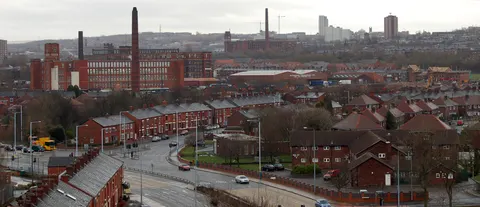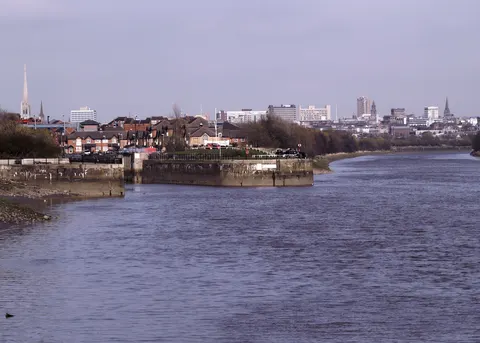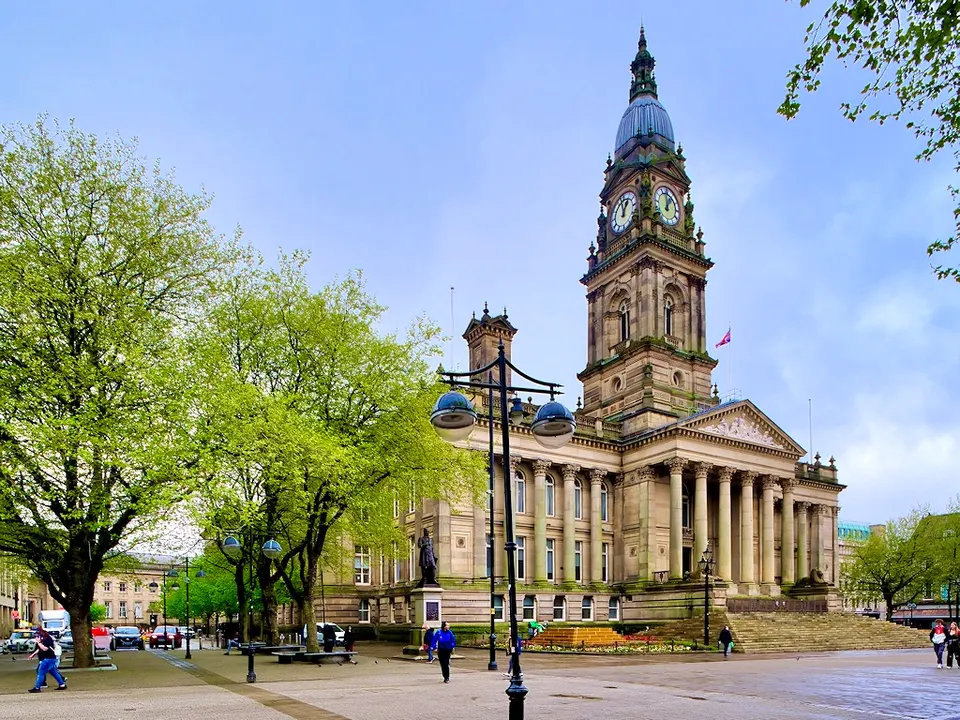

Bolton is a town in Greater Manchester, in the foothills of the West Pennine Moors. It lies between Manchester, Blackburn, Wigan, Bury and Salford, and it is the administrative centre of the wider borough around it. The town sits within the historic county boundaries of Lancashire, and it was once one of the most productive centres of cotton spinning in the world.
Bolton, in England, United Kingdom, is home to about 141,000 people.
Why go to Bolton?
Bolton grew into a mill town during the Industrial Revolution, and cotton shaped its life for generations. The Town Hall is a neoclassical building designed by William Hill, and its Albert Halls were rebuilt after a fire and reopened in 2017. Smithills Hall, whose Great Hall dates from the 14th century, is now a museum. Hall i' th' Wood, a late medieval yeoman farmer's house, is also a museum, and it was once the home of Samuel Crompton. Queen's Park and Leverhulme Park give the town its green spaces, and the views north are dominated by Rivington Pike.
When is the best time to visit Bolton?
In July the average high reaches 19 °C; in January and December it is closer to 6 °C.
How do I get to Bolton without flying?
There are no direct train, bus or ferry links to Bolton yet. You can still search the trip planner for a route with changes.
What to do in Bolton
Town Hall
A Grade II* listed neoclassical building in the town centre, opened by the Prince of Wales in 1873. The Albert Halls are inside it.
Smithills Hall
A Grade I listed hall with a Great Hall and a chapel, where George Marsh was tried for heresy during the Marian Persecutions. It is now a museum.
Hall i' th' Wood
A late medieval yeoman farmer's house, now a museum. It was the place where Samuel Crompton lived and worked.
Queen's Park
A Victorian park in the town, one of the green spaces that surround the centre.