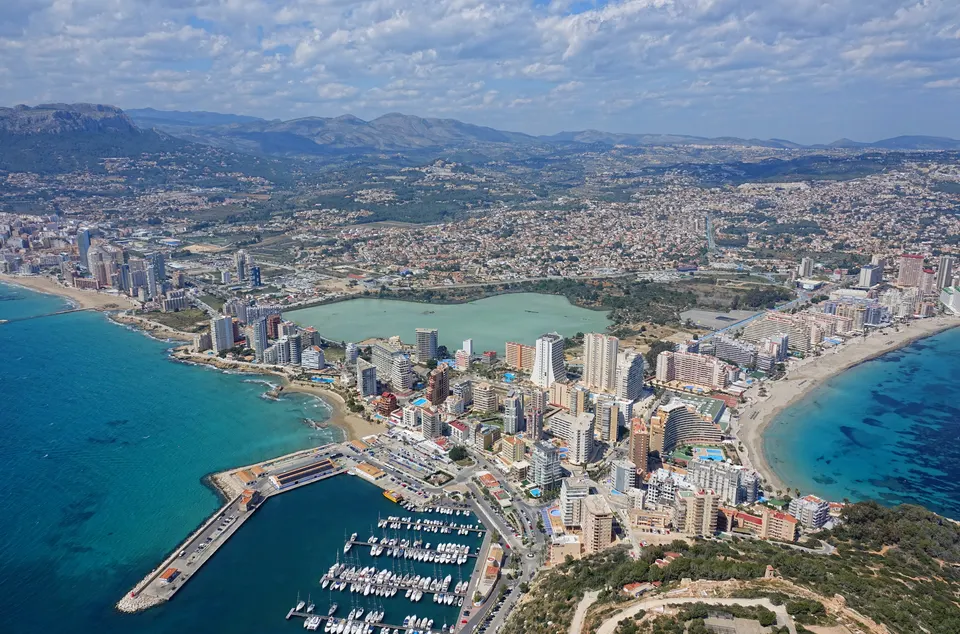

Calp is a coastal town in the Marina Alta comarca of Alicante province, on the Mediterranean in the Valencian Community. It lies at the foot of the Penyal d'Ifac Natural Park, and its economy rests on tourism and fishing. Its strategic coastal position has shaped its history for centuries, and Iberian, Roman and Arab remains lie in and around the town. The Prime Meridian crosses it.
Calp is in Valencia, Spain, and has a population of about 23,000.
Why go to Calp?
Calp is known above all for the Penyal d'Ifac, a steep rock that rises from the shore and stands at the heart of its natural park. The area's inhabitants used it as a lookout, and it remains the town's most recognisable landmark. Below the town, the ruins of Els Banys de la Reina, the Queen's Baths, point to the fish factories and marine trade of this coast. Flooded salt flats draw migratory birds, and the Gothic parish church and an 18th-century tower add older layers to the town centre. Sea, rock and history sit close together here.
When is the best time to visit Calp?
August is the warmest, with highs of about 29 °C, and January is the coolest, at about 14 °C. For beach holidays, go in June, July and September. For nature and hiking trips, go in March, April and November.
How do I get to Calp without flying?
There are no direct train, bus or ferry links to Calp yet. You can still search the trip planner for a route with changes.
What to do in Calp
Penyal d'Ifac
The steep rock at the heart of the natural park, used as a lookout by the area's earliest inhabitants.
Els Banys de la Reina
The Queen's Baths, a ruined Roman-era site that points to the fish factories and marine trade of the coast.
Flooded salt flats
Salt flats that have flooded into a bird sanctuary for migratory birds.
Tower of La Peça
An 18th-century tower from the town's older centre, one of its main monuments.