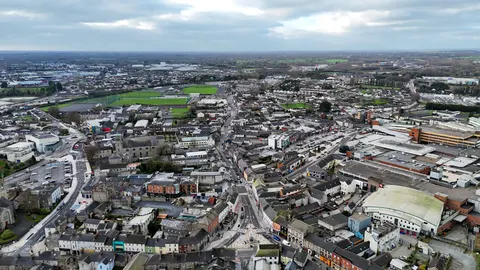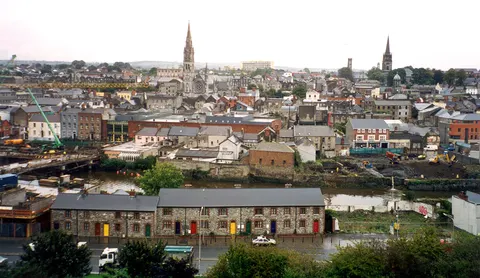

Derry, also called Londonderry, is a cathedral city in Northern Ireland, spread across both banks of the River Foyle. The old walled city sits on the west bank, with Waterside on the east, and two road bridges and a footbridge link the halves. It is the second-largest city in Northern Ireland after Belfast and lies close to the border with County Donegal.
Derry is in Northern Ireland, United Kingdom, and has a population of about 84,000; it is also a rail hub.
Why go to Derry?
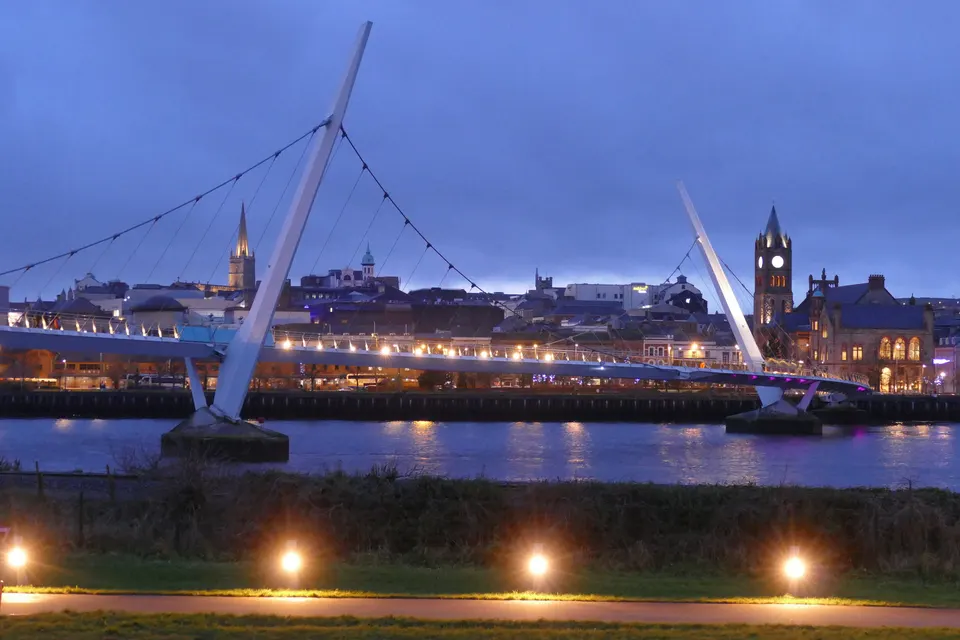
Derry is known for its walls and for the planned streets inside them. The city walls form a continuous promenade around the centre, lined with cannon and mature trees, with views across the city. Inside them, St Columb's Cathedral stands off the grid of streets as the first post-Reformation cathedral built for an Anglican church, and the Guildhall, a red-brick late-Victorian building with a copper dome, stands near the riverfront. In the Bogside, the murals painted by the Bogside Artists turn the district's political history into public art. The Peace Bridge, opened in 2011, is a cycle and footbridge that crosses the Foyle to Ebrington Square.
When is the best time to visit Derry?
July is the warmest, with highs of about 18 °C, and January, February and December are the coolest, at about 7 °C. Any month suits city breaks.
How do I get to Derry without flying?
From 3 destinations you can travel to Derry directly by bus or train. Counting connections, 40 destinations can reach it within 14 hours without flying. Travelling from Belfast, allow 2h 00m by train with Translink; that is about 2 kg of CO₂ per person. From Letterkenny, it takes 33 min by bus with Bus Éireann, with about 0.8 kg of CO₂ per person. The bus from Craigavon with Translink Ulsterbus takes 2h 00m; that is about 2.3 kg of CO₂ per person.
What to do in Derry
St Columb's Cathedral
The Church of Ireland cathedral inside the walls, the first post-Reformation cathedral built for an Anglican church, standing off the city's grid of streets.
The City Walls
A promenade around the city centre, with cannon, avenues of mature trees and views across Derry, and three gates added in the 19th century.
The Bogside murals
Large political gable-wall murals painted by the Bogside Artists in the Bogside district.
Guildhall
A red-brick late-Victorian building crowned by a copper dome, standing just beyond Shipquay Gate near the riverfront.
Peace Bridge
A cycle and footbridge linking the Guild Hall area to Ebrington Square and St Columb's Park on the far side of the Foyle.