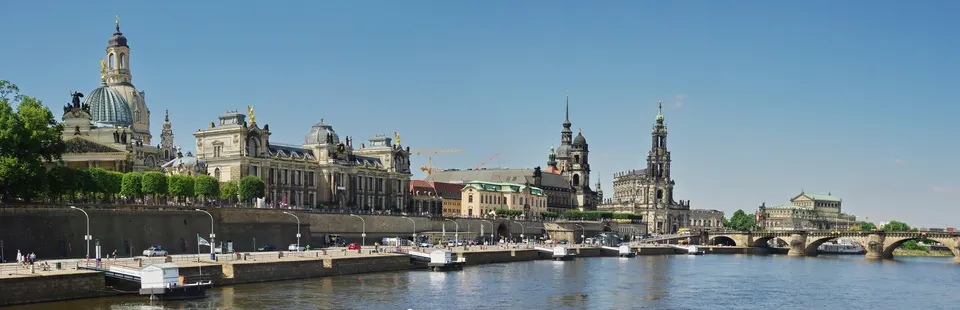

Dresden is the capital of the German state of Saxony and lies on the Elbe, with a metropolitan area of over 1.3 million inhabitants. Known as the Jewel Box for its Baroque and Rococo city centre, it was largely destroyed in the Second World War and rebuilt in the decades after. Its history as a royal residence and the seat of the Saxon electors and kings still shapes the city today, with its art collections and palaces at the centre of its identity.
With about 565,000 inhabitants, Dresden lies in Saxony, Germany, and is a rail hub.
Why go to Dresden?
Dresden's skyline was built around its royal past. The Frauenkirche on the Neumarkt was destroyed in the war, its ruins were left as a memorial for decades, and it was rebuilt between 1994 and 2005. The Zwinger, the Semperoper and Dresden Castle stand among its other famous landmarks. The Dresden State Art Collections grew out of the Saxon electors' holdings and include the Green Vault and the Old Masters Gallery. The Striezelmarkt is one of Germany's largest Christmas markets and is considered the first genuine one in the world. Carl Maria von Weber and Richard Wagner also had works performed here for the first time.
When is the best time to visit Dresden?
Average highs range from 3 °C in January and December to 23 °C in July and August. May, June and September are the time for city breaks.
How do I get to Dresden without flying?
Direct bus, ferry or train services link Dresden with 18 destinations. Allowing for changes, 2,323 destinations are no more than 14 hours away without flying. Berlin is 1h 25m away by train with DB Fernverkehr AG, with about 2.9 kg of CO₂ per person against 38 kg for the flight, 92% less. The bus from Prague with FlixBus-eu takes 1h 40m; that is about 3.2 kg of CO₂ per person. From Hamburg, it takes 6h 10m by bus with FlixBus-eu, with about 10 kg of CO₂ per person against 86 kg for the flight, 88% less.
What to do in Dresden
Frauenkirche
A church on the Neumarkt, built in the 18th century and destroyed in the war, rebuilt from its ruins.
Zwinger
One of the city's most famous landmarks, part of its Baroque centre that gave Dresden its Jewel Box nickname.
Green Vault
One of the museums of the Dresden State Art Collections, housing treasures gathered by the Saxon electors.
Striezelmarkt
A Christmas market considered the first genuine one in the world, and one of the largest in Germany.