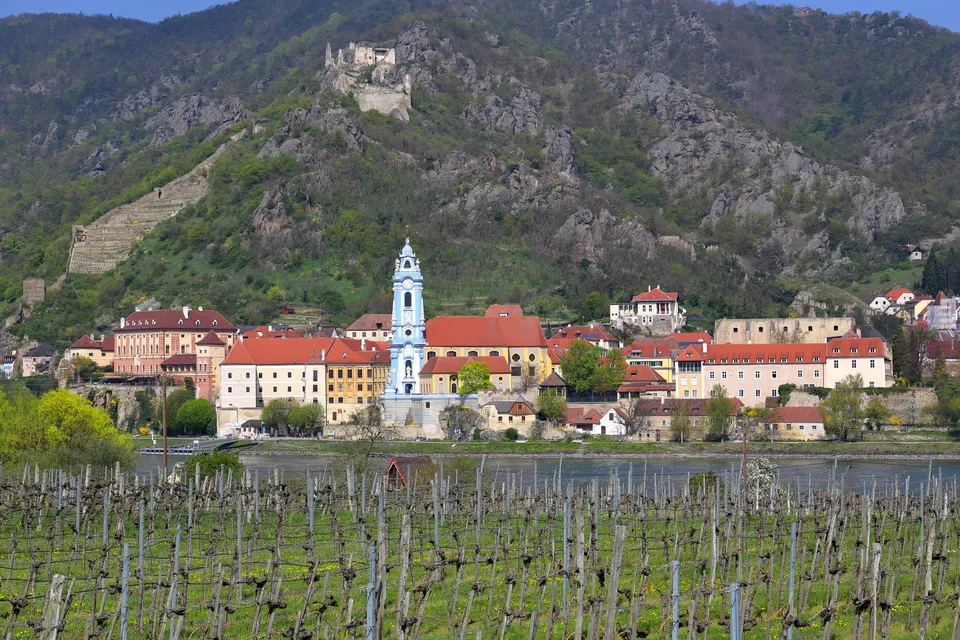

Dürnstein is a small town on the Danube in the Krems-Land district of Lower Austria. It is one of the most-visited tourist destinations in the Wachau region and a well-known wine-growing area. The municipality includes the villages of Oberloiben and Unterloiben. The town was first mentioned in 1192, when King Richard I of England was held captive in the castle above it.
Dürnstein, in Lower Austria, Austria, is home to about 322 people.
Why go to Dürnstein?
Dürnstein is known for its abbey, whose blue tower is clearly visible from the river, and for the castle ruins above the town. Richard the Lionheart was held there after a dispute with Leopold V, Duke of Austria. The abbey was established in 1410 and rebuilt in Baroque style from plans by Joseph Munggenast, Jakob Prandtauer and Matthias Steinl. The area is also a well-known wine-growing region. Nearby, the Battle of Dürenstein was fought during the War of the Third Coalition, in 1805.
When is the best time to visit Dürnstein?
In July the average high reaches 25 °C; in January it is closer to 2 °C.
How do I get to Dürnstein without flying?
Dürnstein has direct bus links to 2 destinations. Within 14 hours, travellers from 2,009 destinations can get here without flying. The bus from Melk with Postbus takes 54 min; that is about 0.6 kg of CO₂ per person. Krems an der Donau is 12 min away by bus with Postbus, with about 0.2 kg of CO₂ per person.
What to do in Dürnstein
Dürnstein Abbey
An abbey established by Canons Regular from Třeboň, famous for its blue tower, which is clearly visible from the river.
Dürnstein Castle
The castle above the town, almost completely destroyed by Swedish troops, where King Richard I of England was held captive.