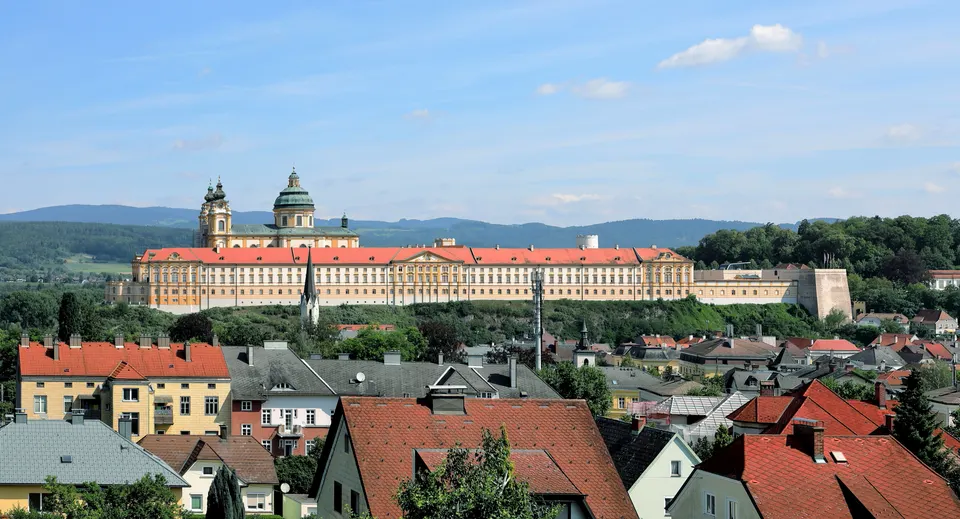

Melk lies in Lower Austria beside the Wachau valley, on the Danube, and is best known for its vast baroque Benedictine monastery, Melk Abbey. In a very small area the town shows architecture from many centuries, from medieval houses to a late Gothic parish church. Just outside the town stands the Renaissance castle Schallaburg, about 5 kilometres south.
With about 3,788 inhabitants, Melk lies in Lower Austria, Austria.
Why go to Melk?
The abbey is the reason most visitors come. It sits on a bluff above the Danube, where a Babenberger castle stood until the site was given to Benedictine monks from Lambach. Below it, the town centre rewards a slow walk. The restored Rathausplatz has a market fountain topped with a statue of St. Koloman, and the town hall beside it has an elaborate wooden and copper entrance door. Behind the square the Sterngasse, the oldest lane in Melk, runs past houses with painted walls. The Haus am Stein, the town's oldest building, is covered by an ancient vine, and remnants of the medieval walls and a Round Tower still line the Danube.
When is the best time to visit Melk?
Average highs range from 2 °C in January to 25 °C in July.
How do I get to Melk without flying?
Direct bus, ferry or train services link Melk with 5 destinations. Allowing for changes, 2,232 destinations are no more than 14 hours away without flying. Vienna is 1h 06m away by train with ÖBB, with about 0.5 kg of CO₂ per person. The train from Linz with ÖBB takes 1h 06m; that is about 0.5 kg of CO₂ per person. From St. Polten, it takes 16 min by train with OEBB Personenverkehr AG Kundenservice, with about 0.1 kg of CO₂ per person.
What to do in Melk
Melk Abbey
A museum in Melk.
Mariä-Himmelfahrt-Kirche
A church in Melk.
Travel on from Melk
Direct links run to Vienna, Linz and St. Polten.