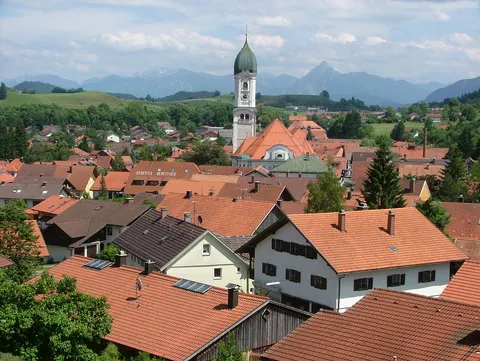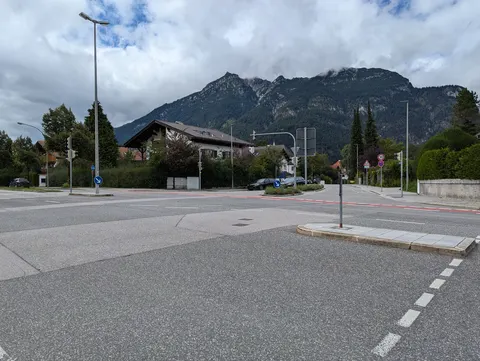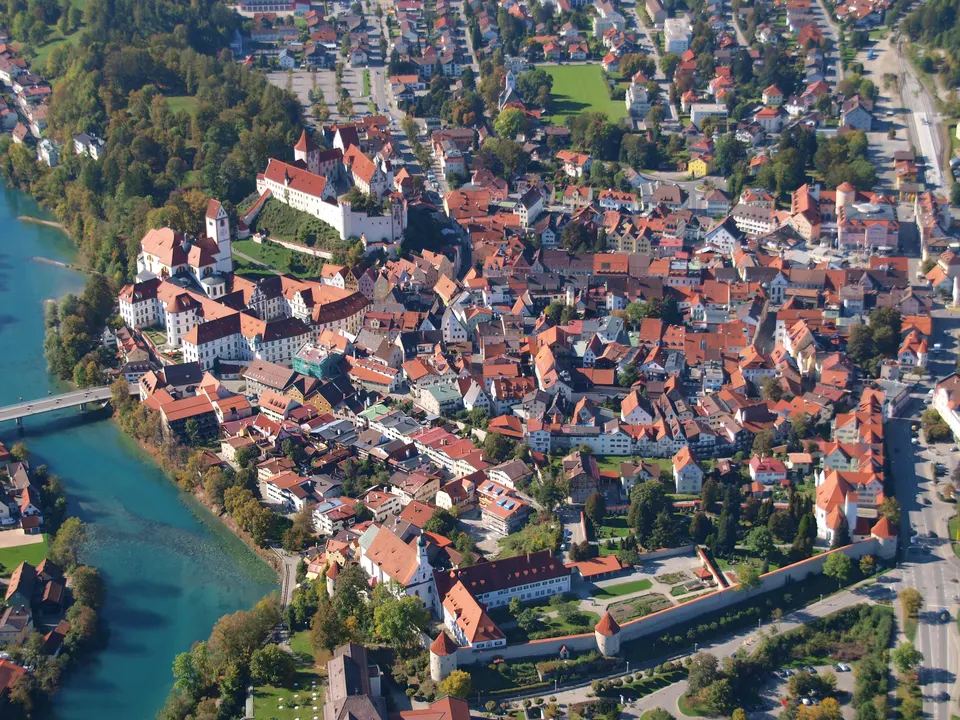

Füssen is a town in Bavaria, in the district of Ostallgäu, one kilometre from the Austrian border. It is known for violin manufacturing and as the transport hub for the Neuschwanstein and Hohenschwangau castles. The town lies on the Lech River among the Ammergau Alps, and the Forggensee beside it is a man-made lake.
Füssen is in Bavaria, Germany, and has a population of about 16,000; it is also a rail hub.
Why go to Füssen?
The High Castle, the former summer residence of the prince-bishops of Augsburg, houses a branch gallery of the Bavarian State Collections of Paintings with late Gothic and Renaissance works. Below it, the Baroque former Benedictine monastery of St. Mang has a crypt with the oldest fresco in Germany, dating to about the year 980. Neuschwanstein and Hohenschwangau castles lie near the town, and Füssen is the southern terminus of the Romantic Road. On St Mang's Feast Day a procession by torchlight winds through the old town, and the local ice hockey club, EV Füssen, is known well beyond the town.
When is the best time to visit Füssen?
July and August are the warmest, with highs of about 21 °C, and January and December are the coolest, at about 2 °C. For nature and hiking trips, go in June, July and August. City breaks work best in May, June and September.
How do I get to Füssen without flying?
From 5 destinations you can travel to Füssen directly by bus or train. Counting connections, 2,356 destinations can reach it within 14 hours without flying. Travelling from Munich, allow 2h 00m by bus with FlixBus-eu; that is about 2.5 kg of CO₂ per person. From Oberstdorf, it takes 1h 05m by bus with FlixBus-eu, with about 1 kg of CO₂ per person. The train from Augsburg with Bayerische Regiobahn takes 1h 44m; that is about 1.6 kg of CO₂ per person.
What to do in Füssen
High Castle
The former summer residence of the prince-bishops of Augsburg, now home to a branch gallery of Bavarian State painting collections.
St Mang's Basilica
A Baroque complex on the site of a Benedictine monastery whose history goes back to the 9th century, with the oldest fresco in Germany in its crypt.
Neuschwanstein Castle
One of the castles near Füssen, alongside Hohenschwangau, and the reason many travellers come to the town.
Forggensee
A man-made lake on the Lech River, built to prevent flooding and drained after the middle of October.