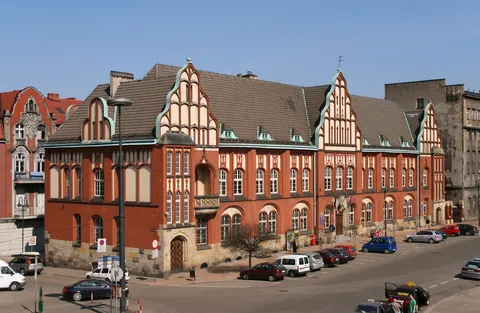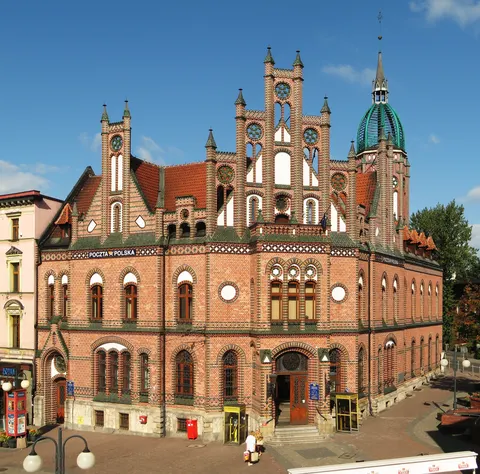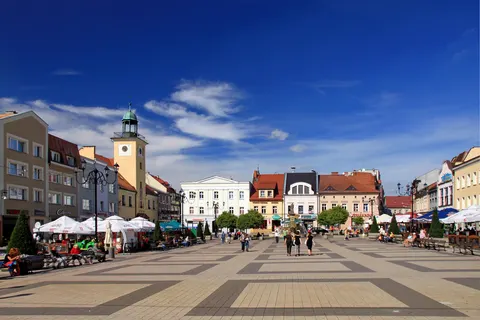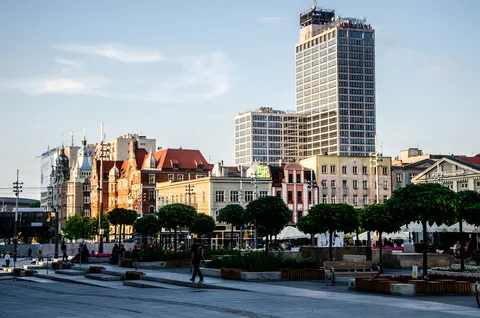

Gliwice is a city in Upper Silesia in southern Poland, on the Kłodnica river, a tributary of the Oder. It sits in the Silesian Highlands and is the westernmost city of the Metropolis GZM conurbation. Once a centre of steelworks and coal mining, it turned to the automotive and machine industries after the 1990s, and it is a university town with a large student population.
Gliwice is in Silesia, Poland, and has a population of about 199,000; it is also a rail hub.
Why go to Gliwice?
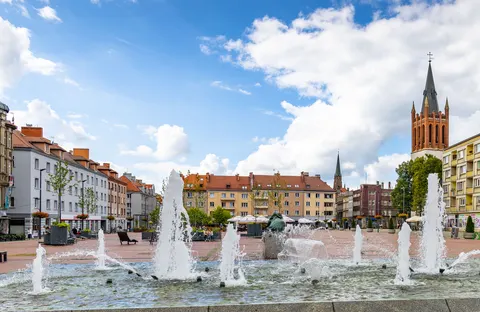
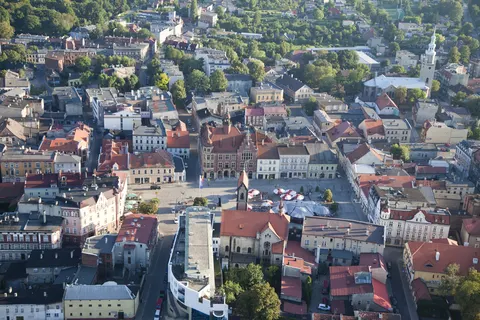
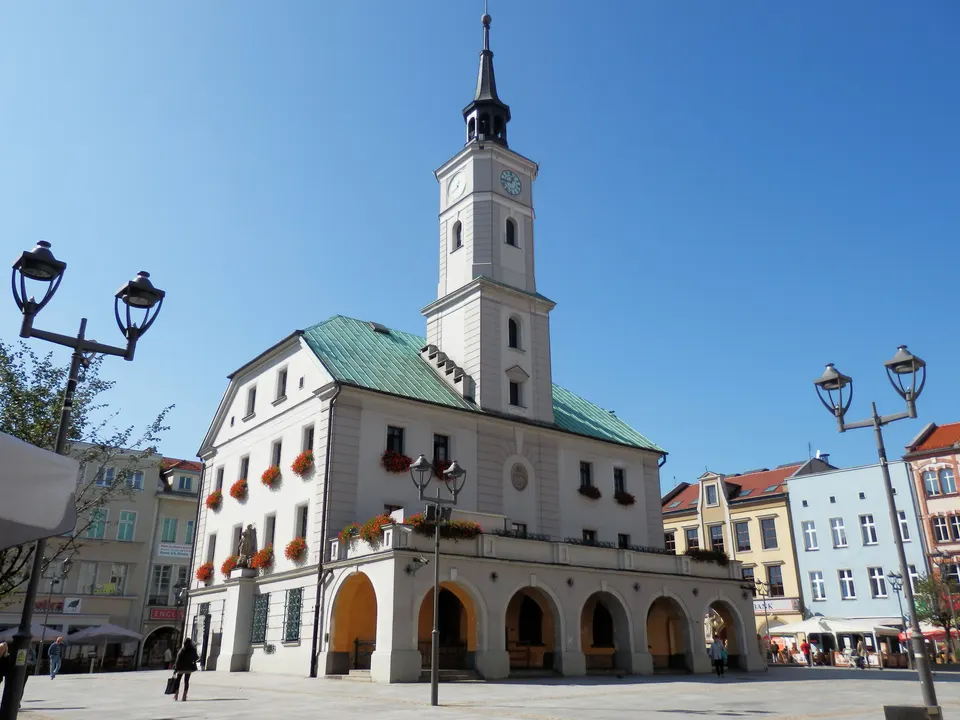
Gliwice is worth a visit for its preserved Old Town, built around a market square with a town hall and a Neptune Fountain. The city's best known landmark is the Radio Tower, the only surviving wooden radio tower in the world and a Historic Monument of Poland. The Baroque Holy Cross Church and the medieval St Bartholomew's Church add to the old centre. Piast Castle and the 14th-century city walls give the centre its medieval character, and Weichmann Textile House, one of the first buildings by Erich Mendelsohn, is a rare early Modernist building in the city.
When is the best time to visit Gliwice?
July and August are the warmest, with highs of about 23 °C, and January is the coolest, at about 1 °C.
How do I get to Gliwice without flying?
From 11 destinations you can travel to Gliwice directly by bus or train. Counting connections, 1,699 destinations can reach it within 14 hours without flying. Travelling from Wroclaw, allow 1h 55m by bus with FlixBus-eu; that is about 4 kg of CO₂ per person. From Opole, it takes 53 min by train with PKP Intercity, with about 2.2 kg of CO₂ per person. The bus from Katowice with FlixBus-eu takes 26 min; that is about 0.7 kg of CO₂ per person.
What to do in Gliwice
Radio Tower
The wooden tower at Szobiszowice is the only remaining radio tower of its kind, and it now forms part of the local museum.
Market Square
The Rynek, with the Town Hall, the Neptune Fountain and colourful historic townhouses in the Old Town.
Piast Castle
A medieval castle that now hosts a branch of the local museum.
Weichmann Textile House
An early Modernist building by Erich Mendelsohn, built in 1921 and 1922, with a monument near its entrance.