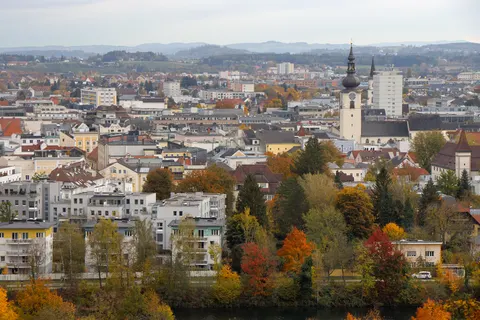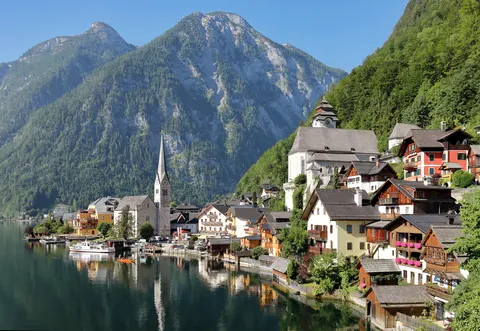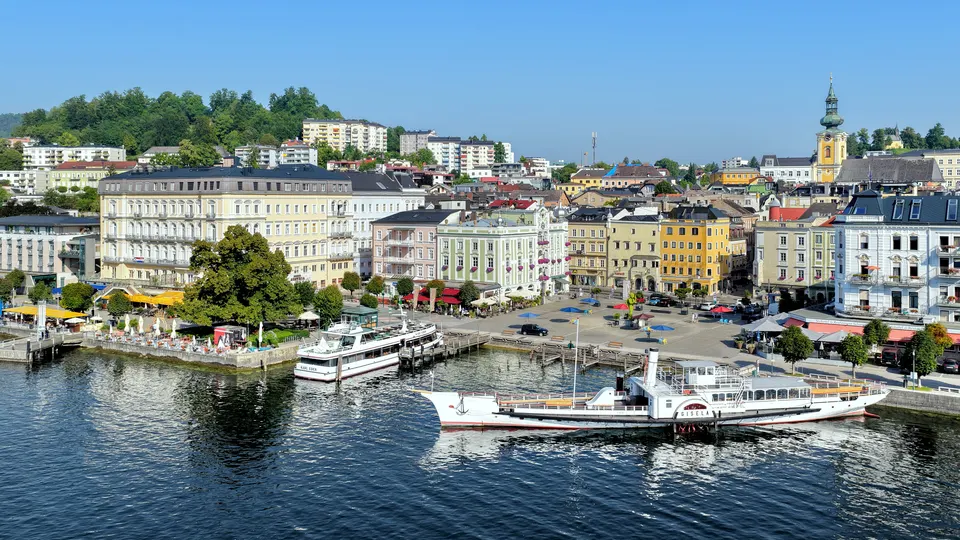

Gmunden is a town in Upper Austria and the seat of the Gmunden district, set on the shore of the Traunsee lake where the Traun River flows. It is surrounded by high mountains, including the Traunstein and the Höllengebirge. Its town rights date from 1278, and salt has been mined here since ancient times.
Gmunden is in Upper Austria, Austria, and has a population of about 13,000.
Why go to Gmunden?
Gmunden has long been a health and summer resort on the Traunsee. It once offered lake, brine and pine-cone baths, a hydropathic establishment and inhalation chambers, and it was an important centre of the salt industry in the Salzkammergut. The mountains that surround the town, including the Traunstein, rise above the lake. Nearby, the Traun Fall lies about 16 kilometres north, and Schloss Ort and the Gmundner Keramik ceramic factory give reasons to explore beyond the lake.
When is the best time to visit Gmunden?
July and August are the warmest, with highs of about 23 °C, and January is the coolest, at about 2 °C.
How do I get to Gmunden without flying?
From 3 destinations you can travel to Gmunden directly by train. Counting connections, 2,298 destinations can reach it within 14 hours without flying. Travelling from Linz, allow 47 min by train with OEBB Personenverkehr AG Kundenservice; that is about 0.4 kg of CO₂ per person. From Ebensee, it takes 18 min by train with OEBB Personenverkehr AG Kundenservice, with about 0.1 kg of CO₂ per person. The train from Wels with OEBB Personenverkehr AG Kundenservice takes 45 min; that is about 0.2 kg of CO₂ per person.
What to do in Gmunden
Grünberg
A mountain in Gmunden.
Gmunden Stadtpfarrkirche
A church in Gmunden.
Travel on from Gmunden
Direct links run to Linz, Ebensee and Wels.