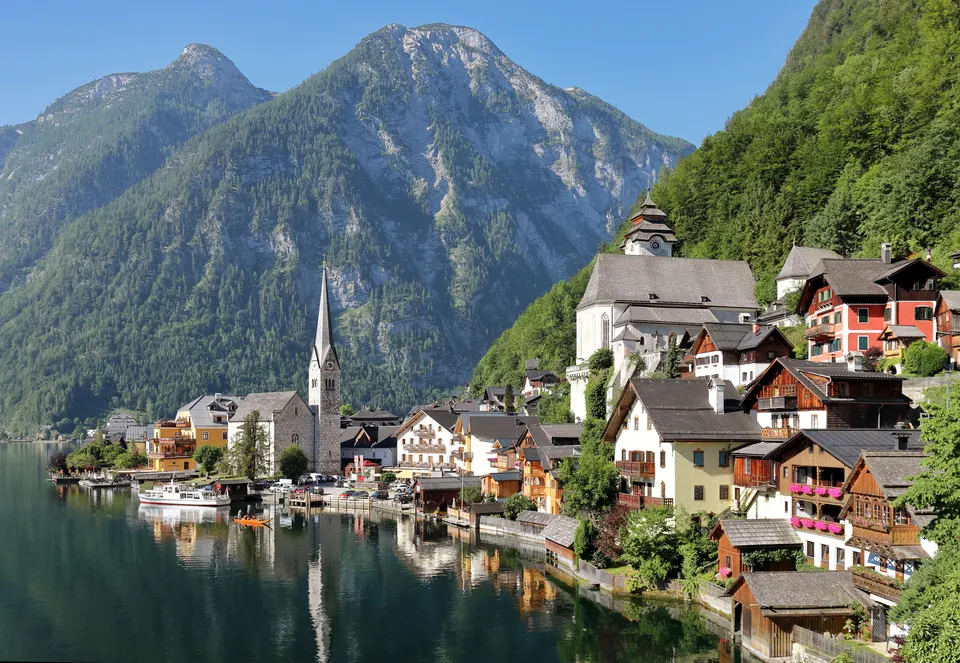

Hallstatt is a small town in the Gmunden District of Upper Austria, lying between the southwestern shore of the Hallstätter See and the steep slopes of the Dachstein massif. It sits in the Salzkammergut region, on the national road linking Salzburg and Graz. Salt has been produced here since prehistoric times, and the archaeological culture named after the town dates to the early Iron Age. The town is part of a UNESCO World Heritage cultural landscape and is well known for its tourism.
About 779 people live in Hallstatt, in Austria.
Why go to Hallstatt?
Hallstatt is a town where the past lies in the ground and the view lies in front of you. Prehistoric salt mining left an unusual record, because the salt preserved textiles, wood and leather from the mine workings, along with shoes, pieces of cloth, tools and miners' backpacks. The town occupies a narrow strip between the hillside and the lake, and the Dachstein massif rises straight behind it. Its UNESCO listing as part of a cultural landscape has drawn visitors for decades, and its tourism grew sharply after the listing. The grave goods found in the cemetery are distinctive in both style and decoration.
When is the best time to visit Hallstatt?
Expect daytime highs of about 22 °C in July and August, falling to 1 °C in January. For skiing, go in January, February and December.
How do I get to Hallstatt without flying?
You can get to Hallstatt without changing from 2 destinations, by train. With changes, Hallstatt is within 14 hours of 2,017 destinations without flying. From Bad Ischl, it takes 20 min by train with OEBB Personenverkehr AG Kundenservice, with about 0.1 kg of CO₂ per person. Travelling from Tauplitz, allow 35 min by train with OEBB Personenverkehr AG Kundenservice; that is about 0.2 kg of CO₂ per person.
What to do in Hallstatt
Hallstätter See
The lake along whose shore the town is built, with the Dachstein massif rising steeply behind it.
Salzberg prehistoric cemetery
Excavated from the second half of the 19th century, its graves show the wealth of the early salt trade.
Hallstatt-Dachstein/Salzkammergut Cultural Landscape
A cultural landscape declared a UNESCO World Heritage Site in 1997.
Find tours and tickets: Hallstatt-Dachstein/Salzkammergut Cultural Landscape