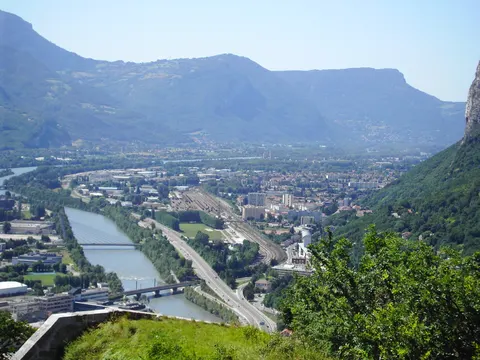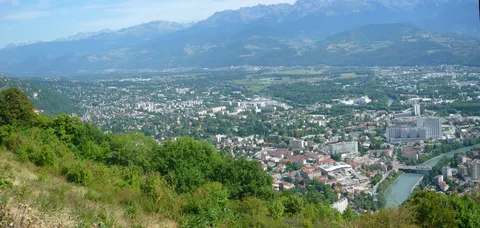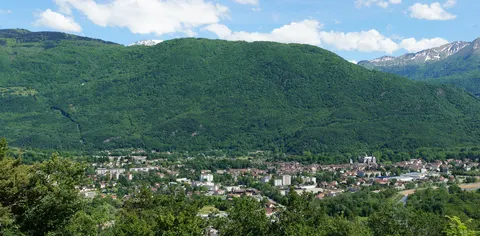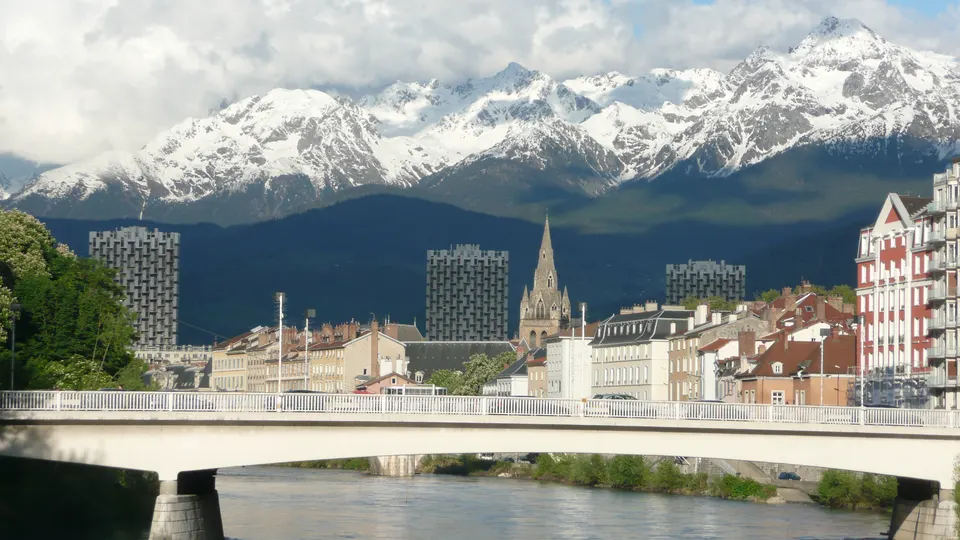

Grenoble sits where the Drac flows into the Isère at the foot of the French Alps, so mountains rise right behind the city's streets. That contrast of rivers and high peaks gives the place a sharp, outdoor edge. The old centre is compact and lively, with cathedral squares and museums close to the water, while the modern quarters spread out toward the hills.
Grenoble is in Auvergne-Rhône-Alpes, France, and has a population of about 159,000; it is also a rail hub.
Why go to Grenoble?
Come to Grenoble for a city where culture and mountains sit side by side. Grenoble Cathedral and the Collegiate Church of Saint-André, Grenoble stand in the old centre, while the Museum of Grenoble and the Museum of the Old Archbishopric give two different views of the town's past. The Musée de la Résistance et de la Déportation à Grenoble is a serious, reflective stop, and Le Magasin des horizons adds another kind of museum. The Perret tower (Grenoble) gives a wide view over the city and the hills. The Pont d'Oxford is a good bridge for a walk, and the Basilique du Sacré-Cœur de Grenoble and Basilique Saint-Joseph de Grenoble make calm finishes. The city suits a culture-led trip with mountain walks close at hand.
When is the best time to visit Grenoble?
July is the warmest, with highs of about 27 °C, and January is the coolest, at about 6 °C. Any month suits city breaks.
How do I get to Grenoble without flying?
From 26 destinations you can travel to Grenoble directly by bus or train. Counting connections, 2,142 destinations can reach it within 14 hours without flying. Travelling from Paris, allow 2h 59m by train with SNCF VOYAGEURS; that is about 1.2 kg of CO₂ per person, 99% less than the 110 kg of a flight. From Dijon, it takes 4h 20m by bus with FlixBus-eu, with about 6.6 kg of CO₂ per person against 56 kg for the flight, 88% less. The bus from Toulouse with BlaBlaCar Bus takes 6h 50m; that is about 10 kg of CO₂ per person, 89% less than the 88 kg of a flight.
What to do in Grenoble
Perret tower (Grenoble)
Visit the Perret tower (Grenoble) for a wide view over the city and the surrounding mountains. It is a clear way to read the layout of the valley all at once.
Grenoble Cathedral
Grenoble Cathedral sits in the old centre and makes a calm place to pause on a walk. Step inside, then wander the nearby lanes at your own pace.
Wartime history museum
The Musée de la Résistance et de la Déportation à Grenoble is a serious, moving museum about the region's wartime story. Allow time for the displays and take a quiet moment afterwards.
Pont d'Oxford
Cross the Pont d'Oxford for views along the river and toward the hills. It is a short walk with plenty to look at, especially on a clear day.