
Hall in Tirol is a town in the Innsbruck-Land district of Tyrol, Austria, about 5 kilometres east of Innsbruck in the Inn valley. Its population is about 14,800. Its name comes from the Celtic word for salt, and the town grew rich from the salt mine at Absam and from the trade that followed the Inn river.
Hall in Tirol, in Tyrol, Austria, is home to about 13,000 people and works as a rail hub.
Why go to Hall in Tirol?
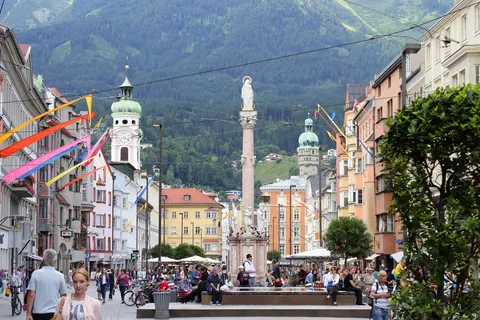
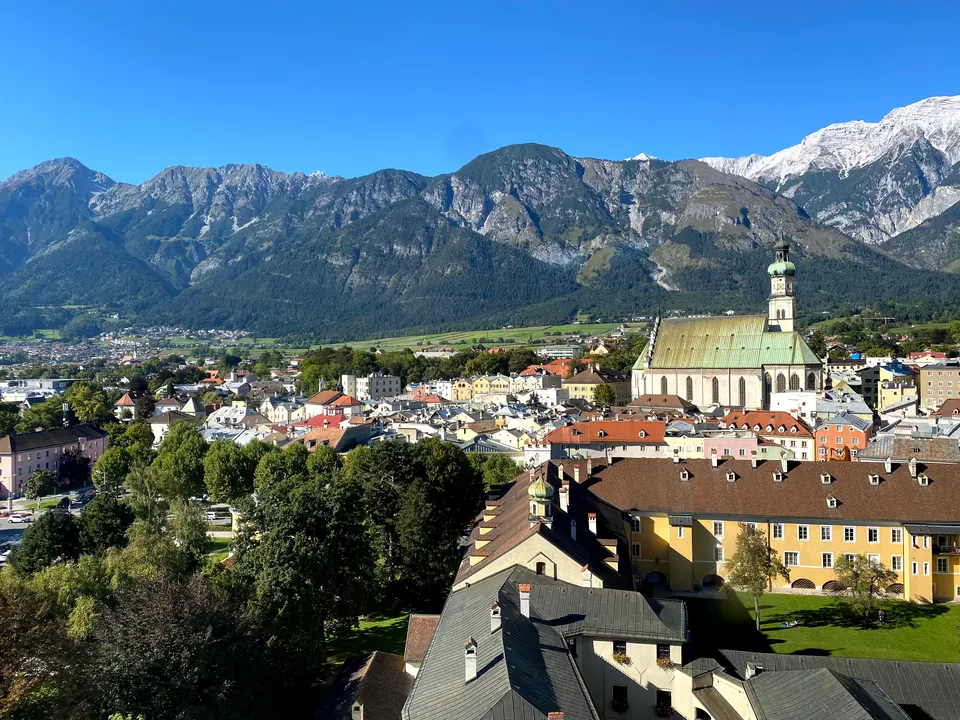
Hall has the biggest intact old town in western Austria. Its churches, monasteries and convents date from the 15th and 16th centuries, when it was one of the most important towns in the Habsburg Empire. The Hall Mint Museum in the Burg Hasegg shows a reconstruction of the world's first automated coining machine, and the town's mint produced the first large silver coin in Europe. The old town was left almost unscathed when bombing destroyed the railway station in the Second World War.
When is the best time to visit Hall in Tirol?
In July and August the average high reaches 23 °C; in January and December it is closer to 4 °C. For city breaks, go in May, June and September.
How do I get to Hall in Tirol without flying?
Hall in Tirol has direct bus or train links to 6 destinations. Within 14 hours, travellers from 2,502 destinations can get here without flying. The train from Mayrhofen with Zillertalbahn takes 1h 24m; that is about 0.2 kg of CO₂ per person. Schwaz is 9 min away by train with OEBB Personenverkehr AG Kundenservice, with about 0.1 kg of CO₂ per person. Travelling from Wattens, allow 3 min by train with OEBB Personenverkehr AG Kundenservice; that is about 0 kg of CO₂ per person.
What to do in Hall in Tirol
Hall Mint Museum
In the Burg Hasegg, a museum with a reconstruction of the world's first automated coining machine.
Old town of Hall
The biggest intact old town in western Austria, shaped by churches, monasteries and convents from the Habsburg era.
Absam salt mine
A salt mine in the Hall Valley north of the town, closed in the 1960s.