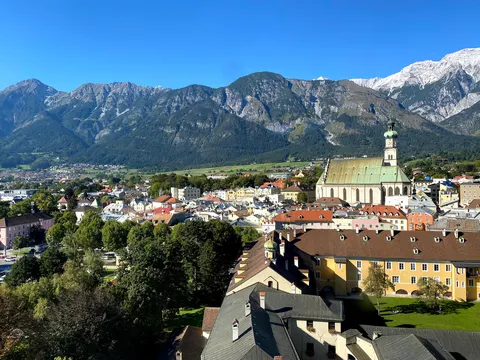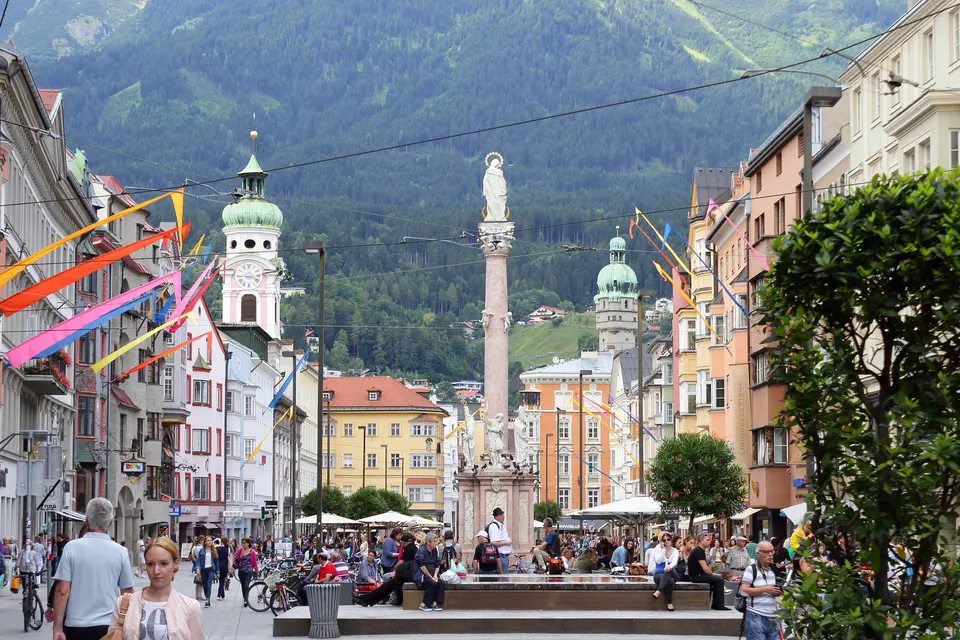

Innsbruck is the state capital of Tyrol in Austria. This part of the city takes in the historic old town and the former Neustadt, with its Maria-Theresien-Straße, along with the Saggen and Dreiheiligen districts. Mariahilf and St. Nikolaus lie on the left bank of the Inn. Until the first incorporations in 1904, this area was the whole of the city.
With about 132,000 inhabitants, Innsbruck lies in Tyrol, Austria, and is a rail hub.
Why go to Innsbruck?
Innsbruck's historic old town is the heart of this part of the city. Beyond it lies the former Neustadt, where Maria-Theresien-Straße is the main street. The districts of Saggen and Dreiheiligen sit alongside, and Mariahilf and St. Nikolaus lie across the Inn on its left bank. Until the first incorporations in 1904, this whole area was the city itself, so it shows how Innsbruck grew outward from its centre. Walking from the old town into the former Neustadt takes you along the Maria-Theresien-Straße, from the medieval quarter to the newer streets of the town.
When is the best time to visit Innsbruck?
Average highs range from 4 °C in January to 23 °C in July and August. Skiing works best in January, February and December. May, June and September are the time for city breaks.
How do I get to Innsbruck without flying?
Direct bus or train services link Innsbruck with 23 destinations. Allowing for changes, 2,573 destinations are no more than 14 hours away without flying. Garmisch-Partenkirchen is 1h 05m away by bus with FlixBus-eu, with about 0.9 kg of CO₂ per person. The train from Munich with DB/ÖBB takes 1h 30m; that is about 2 kg of CO₂ per person. From Verona, it takes 3h 00m by train with ÖBB/Trenitalia, with about 4 kg of CO₂ per person against 26 kg for the flight, 85% less.
What to do in Innsbruck
Ambras Castle
A museum in Innsbruck.
Golden Roof
A museum in Innsbruck.
Bergisel
A mountain in Innsbruck.
Innsbruck Cathedral
A cathedral in Innsbruck.
Skiing in Innsbruck
January is the ideal month for skiing, with average highs of 4 °C.