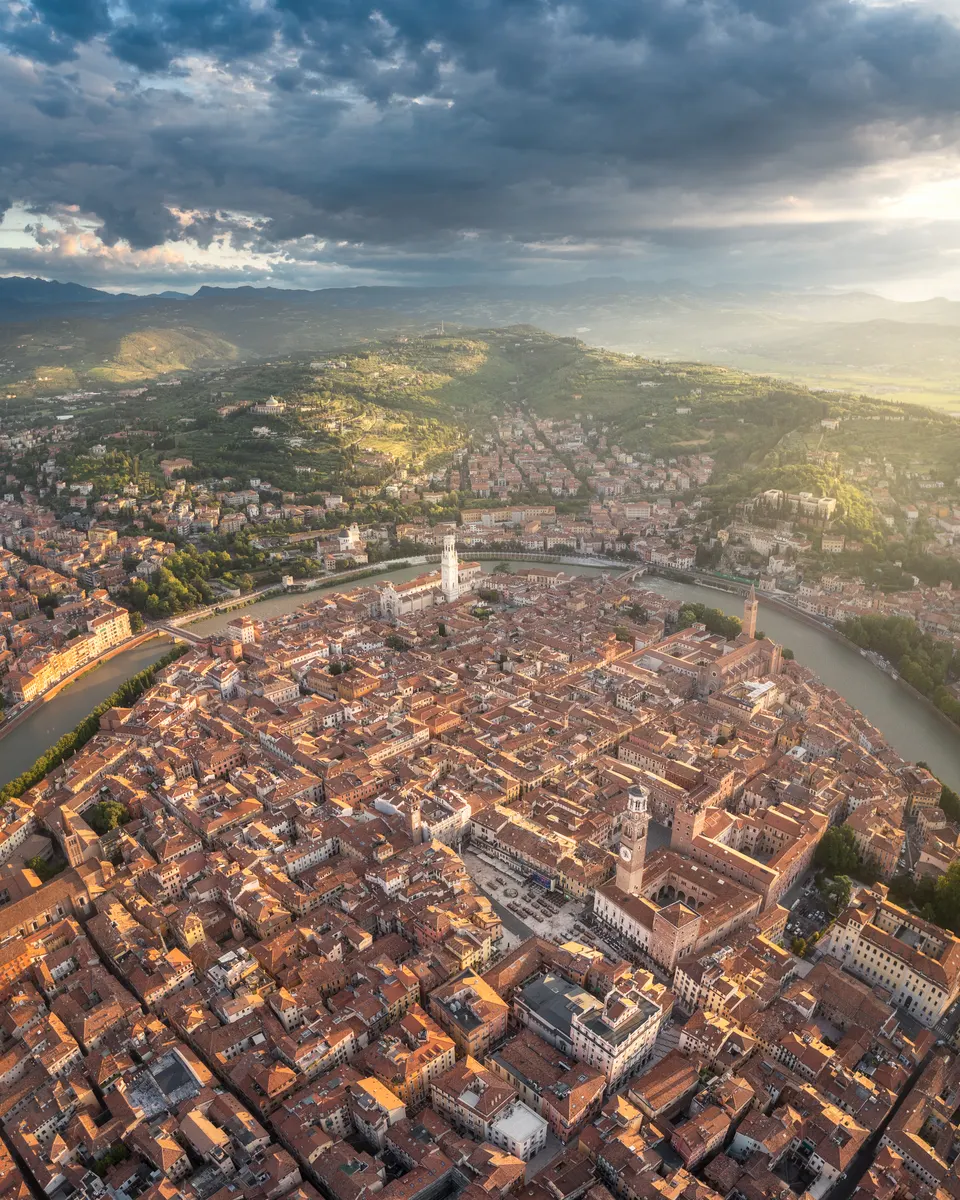

Verona is the largest city in the Veneto region of northern Italy and one of its main tourist destinations. Its heritage includes an ancient Roman amphitheatre, the Arena, which still hosts an opera season, and a medieval centre that flourished under the della Scala family. Shakespeare set three of his plays here, and the Casa di Giulietta draws visitors. UNESCO has listed the city as a World Heritage Site.
With about 258,000 inhabitants, Verona lies in Veneto, Italy, and is a rail hub.
Why go to Verona?
Verona rewards time spent on foot. The Arena, one of the great ancient Roman buildings still in use, dominates the centre, and its opera season fills it. The Basilica of San Zeno Maggiore, a Romanesque church with a warm golden facade, stands over the shrine of the city's patron saint and has bronze doors with biblical scenes. The Piazza dei Signori, an elegant medieval square with a monument to Dante, is another stop. The Casa di Giulietta, a medieval house tied to Shakespeare's Capulets, turns the city's literary fame into a visit.
When is the best time to visit Verona?
Average highs range from 7 °C in January to 29 °C in July. For city breaks, any month of the year works.
How do I get to Verona without flying?
Direct bus or train services link Verona with 23 destinations. Allowing for changes, 2,378 destinations are no more than 14 hours away without flying. Munich is 5h 28m away by bus with FlixBus-eu, with about 8.2 kg of CO₂ per person against 39 kg for the flight, 79% less. The train from Milan with Trenitalia takes 1h 12m; that is about 1 kg of CO₂ per person. From Venice, it takes 1h 12m by train with Trenitalia, with about 1 kg of CO₂ per person.
What to do in Verona
Arena di Verona
The ancient Roman amphitheatre that hosts the opera season, still used for performances in the city centre.
Basilica di San Zeno Maggiore
A Romanesque church built over a fourth-century shrine to St. Zeno, with a bell tower that Dante mentions in the Divine Comedy.
Casa di Giulietta
A medieval house linked to Shakespeare's Capulets, converted into a museum in the 1930s when its courtyard balcony was added.
Santa Maria Antica
A small Romanesque chapel that served as the private church of the Scaligeri clan and holds the famous Scaliger Tombs.