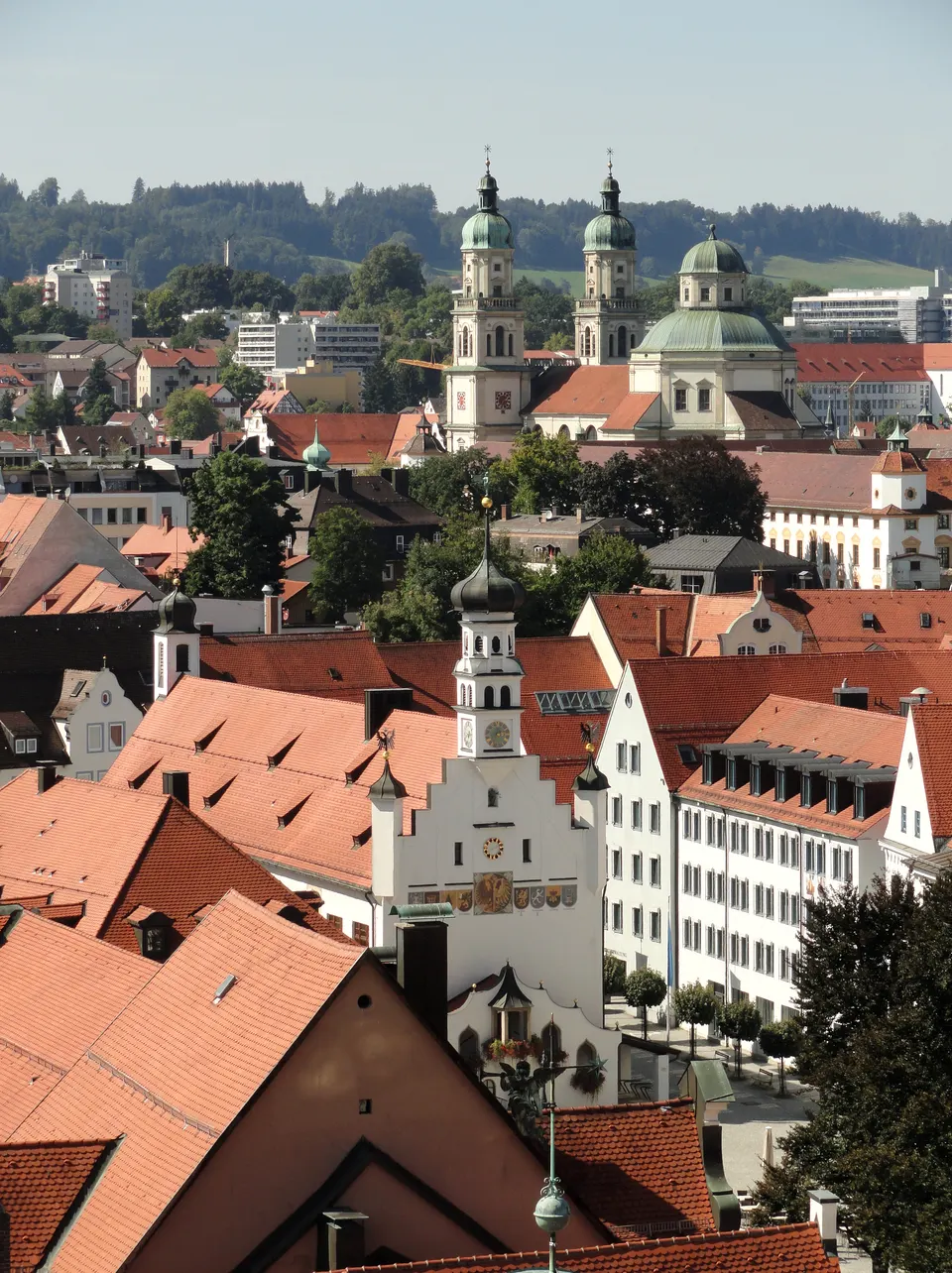

Kempten is the largest town of the Allgäu region, in Swabia, Bavaria, Germany. Its population was about 68,000 in 2016. The Celts may have settled the area first, before the Romans took it over and called the town Cambodunum. It is one of the oldest urban settlements in Germany.
About 61,000 people live in Kempten (Allgäu), in Bavaria, Germany, and its station is a rail hub.
Why go to Kempten (Allgäu)?
Kempten's appeal is its depth of history. The Romans called it Cambodunum, and the Archaeological Park Cambodunum keeps that past in view. The Duke-Abbots' Residence stands in the old centre, along with the St. Lorenz Basilica, a minor basilica, and the St. Mang Church. The City Hall and its square form the civic heart, and the Burghalde, a ruin, is also part of the town. Beneath the streets lies the Erasmuskapelle, an underground chapel. The mix of Roman remains and medieval churches makes the town a rewarding stop.
When is the best time to visit Kempten (Allgäu)?
Expect daytime highs of about 21 °C in July and August, falling to 3 °C in January and December. If you are after city breaks, aim for May, June and September.
How do I get to Kempten (Allgäu) without flying?
You can get to Kempten (Allgäu) without changing from 6 destinations, by train. With changes, Kempten (Allgäu) is within 14 hours of 2,521 destinations without flying. From Munich, it takes 1h 38m by train with DB Regio AG Bayern, with about 1.8 kg of CO₂ per person. Travelling from Ulm, allow 53 min by train with DB Fernverkehr AG; that is about 1.4 kg of CO₂ per person. Immenstadt im Allgäu is 13 min away by train with DB Regio AG Bayern, with about 0.4 kg of CO₂ per person.
What to do in Kempten (Allgäu)
St. Lorenz Basilica
A minor basilica that is among the town's principal sights.
Archaeological Park Cambodunum
The site of the Roman town of Cambodunum, now an archaeological park.
Duke-Abbots' Residence
The former residence of the duke-abbots, in the old centre.
Erasmuskapelle
An underground chapel in the town.