
Le Puy-en-Velay is the prefecture of the Haute-Loire department in south-central France, set near the river Loire. The town is known for its cathedral, for a kind of lentil and for its lace-making. It is also the origin of the Chemin du Puy, one of the main routes of the Santiago de Compostela pilgrimage in France, and its population is about 18,540.
Le Puy-en-Velay, in Auvergne-Rhône-Alpes, France, is home to about 23,000 people and works as a rail hub.
Why go to Le Puy-en-Velay?
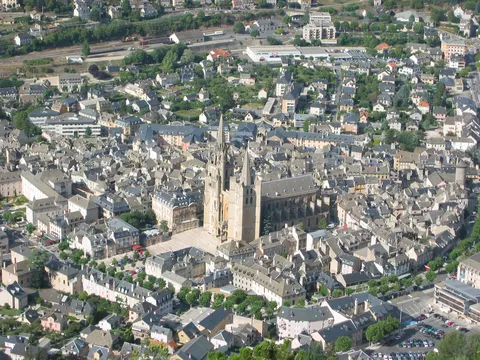
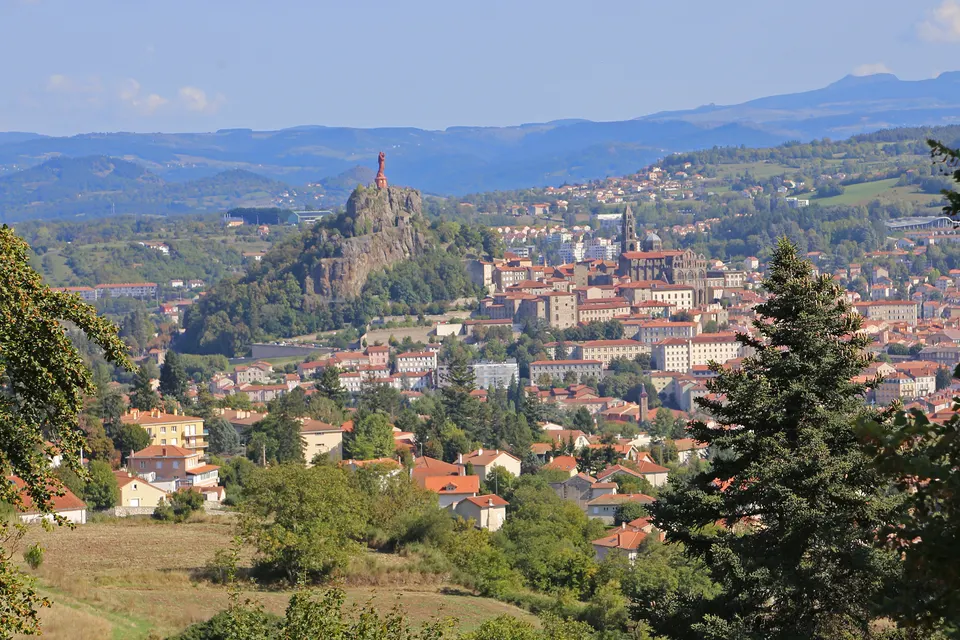
The cathedral is the town's centrepiece. Its striped façade of white sandstone and black volcanic breccia is reached by sixty steps, and a Romanesque bell tower stands behind the choir. The striking parti-coloured cloister sits beside the cathedral. Above the town, the iron statue of Notre-Dame de France was made from Russian cannons taken in the Siege of Sevastopol. Pilgrims gather for a blessing each morning before setting out for Santiago de Compostela. Outside the town, the ruins of the Château de Polignac, one of the region's most important feudal strongholds, stand as a reminder of the medieval power here. The cathedral has been a UNESCO World Heritage Site since 1998.
When is the best time to visit Le Puy-en-Velay?
In July and August the average high reaches 24 °C; in January it is closer to 5 °C. Any month suits city breaks.
How do I get to Le Puy-en-Velay without flying?
Le Puy-en-Velay has direct bus or train links to 3 destinations. Within 14 hours, travellers from 1,857 destinations can get here without flying. The train from Clermont-Ferrand with Société Nationale des Chemins de fer Français takes 2h 11m; that is about 0.3 kg of CO₂ per person. Monistrol-sur-Loire is 44 min away by train with SNCF VOYAGEURS, with about 0.1 kg of CO₂ per person. Travelling from Bleymard - Mont Lozère, allow 2h 12m by bus; that is about 1.8 kg of CO₂ per person.
What to do in Le Puy-en-Velay
Cathédrale Notre-Dame du Puy
A Romanesque cathedral reached by a flight of steps, with a seven-storey bell tower behind the choir.
Notre-Dame de France
An iron statue of the Virgin Mary overlooking the town, made from Russian cannons taken at Sevastopol.
Baptistery of St John
An 11th-century baptistery built on Roman foundations, next to the cathedral.
Fountain Crozatier
A noted fountain in the centre of the town.