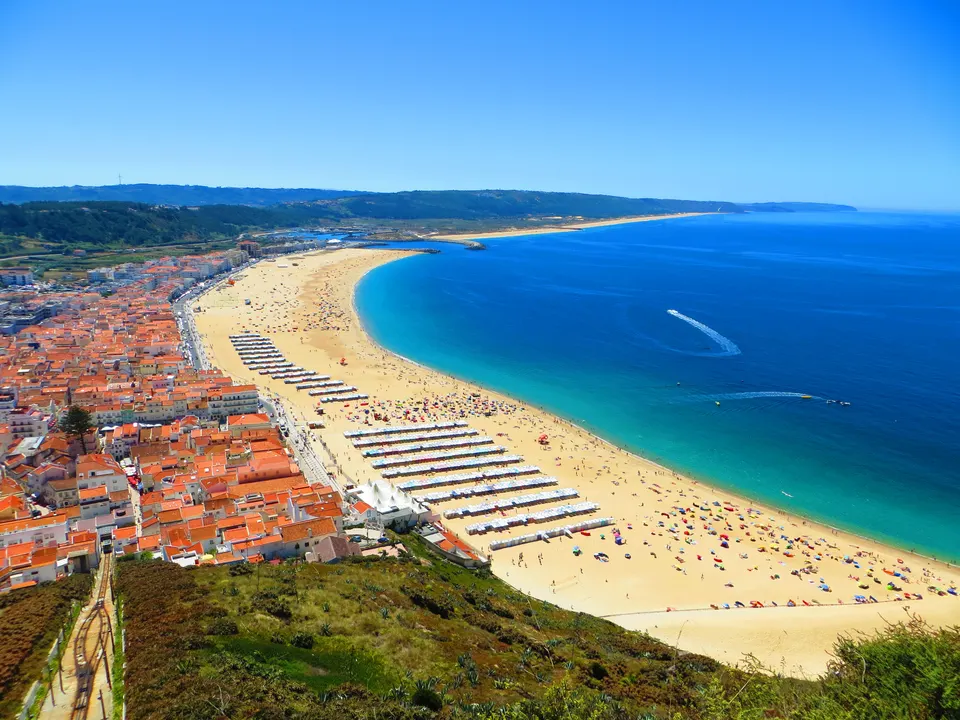

Nazaré is a Portuguese resort town on the Silver Coast, in the Oeste region and the Leiria District. It grew from a fishing village into a seaside destination and is best known for its huge waves and the surfing competitions they draw. The town has three neighbourhoods: Praia along the beach, Sítio on a cliff and Pederneira on a hilltop. Its Our Lady of Nazaré festival draws pilgrims and tourists alike.
About 8,993 people live in Nazaré, in Leiria, Portugal.
Why go to Nazaré?
Most visitors come for the waves, and the tallest wave ever surfed was ridden at Nazaré in 2020. The Nazaré Funicular links Praia with the old village of Sítio on the cliff, where the Sanctuary of Our Lady of Nazaré stands as a rich baroque building. Beside it, a chapel sits over the small grotto where the town's miraculous statue was placed, and a rocky outcrop rises above the Atlantic. Women's traditional costume, a headscarf and an embroidered flannel skirt, is still worn occasionally, and the festival brings processions, bullfights, fireworks, folk dancing and a fair.
When is the best time to visit Nazaré?
Expect daytime highs of about 23 °C in July, August and September, falling to 13 °C in January.
How do I get to Nazaré without flying?
You can get to Nazaré without changing from 2 destinations, by bus. With changes, Nazaré is within 14 hours of 188 destinations without flying. From Lisbon, it takes 1h 54m by bus, with about 2.7 kg of CO₂ per person. Travelling from Leiria, allow 35 min by bus with FlixBus-eu; that is about 0.7 kg of CO₂ per person.
What to do in Nazaré
Nazaré Funicular
A funicular railway that connects the beach at Praia with the old village of Sítio on the cliff above.
Sanctuary of Our Lady of Nazaré
A rich baroque sanctuary at Sítio, the centre of the town's devotion to Our Lady of Nazaré.
Capela da Memória
A chapel built over the small grotto where the town's miraculous statue was placed, beside a rocky outcrop above the Atlantic.