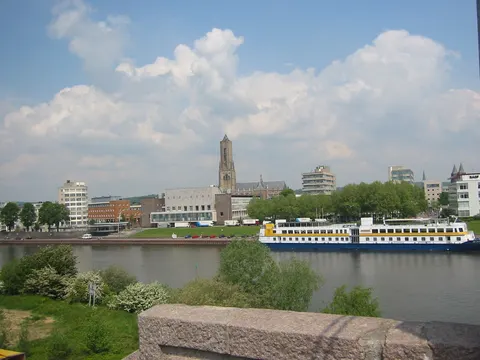
Nijmegen is the largest city in the Dutch province of Gelderland and the ninth-largest in the Netherlands as a whole. It lies on the Waal river close to the German border, and it is one of the oldest cities in the country, recognised as a city already in Roman times. The city has been a university centre since 1923, when a Catholic institution opened that is now known as Radboud University Nijmegen.
With about 177,000 inhabitants, Nijmegen lies in Gelderland, Netherlands, and is a rail hub.
Why go to Nijmegen?
Nijmegen has a long history on the Waal river. It became a free imperial city and later a Hanseatic city, and it is one of the oldest cities in the Netherlands, first recognised as a city in Roman times. In 2005 it celebrated 2,000 years of existence. It is also a university city, home to Radboud University Nijmegen. Its best-known event is the Vierdaagse, the International Four Days Marches Nijmegen, which brings walkers to the city every year. The city is the largest in Gelderland, ninth largest in the country, and lies close to the German border on the Waal.
When is the best time to visit Nijmegen?
Average highs range from 5 °C in January and December to 22 °C in July and August. For city breaks, any month of the year works.
How do I get to Nijmegen without flying?
Direct bus or train services link Nijmegen with 8 destinations. Allowing for changes, 2,200 destinations are no more than 14 hours away without flying. Eindhoven is 55 min away by bus with FlixBus-eu, with about 1.4 kg of CO₂ per person. The train from Arnhem with NS takes 12 min; that is about 0.3 kg of CO₂ per person. From Essen, it takes 1h 31m by bus with FlixBus-eu, with about 2.5 kg of CO₂ per person.
What to do in Nijmegen
Vierdaagse
The International Four Days Marches Nijmegen, an annual walking event that the city is best known for.