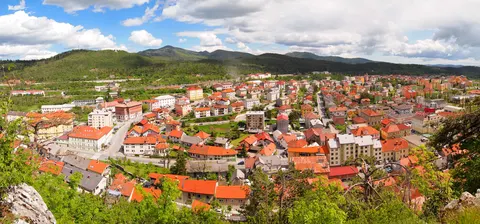
Nowy Targ is the largest town and the historic capital of Podhale, a region in southern Poland within the Lesser Poland Voivodeship. It lies in the Orava-Nowy Targ Basin at the foot of the Gorce Mountains, where the Czarny Dunajec and Biały Dunajec rivers meet. It is the seat of Nowy Targ County and the main commercial and industrial centre of the region. The town has a state vocational university and the highest-located airport in Poland.
Nowy Targ is in Lesser Poland, Poland, and has a population of about 34,000; it is also a rail hub.
Why go to Nowy Targ?
Nowy Targ keeps much of its medieval layout. King Casimir the Great founded the town in 1346, building on the older border settlement of Stare Cło, and its market square and historic architectural complex have been preserved. A weekly open-air market, first granted in the 15th century, still runs on Thursday and Saturday mornings. The Museum of Podhale and the Jatka Gallery offer a look at the local culture of the Podhale region, and the town's history as a border and trading place is still visible in its centre.
When is the best time to visit Nowy Targ?
July and August are the warmest, with highs of about 21 °C, and January and December are the coolest, at about 0 °C. For nature and hiking trips, go in June, July and August.
How do I get to Nowy Targ without flying?
From 9 destinations you can travel to Nowy Targ directly by bus or train. Counting connections, 1,006 destinations can reach it within 14 hours without flying. Travelling from Zakopane, allow 14 min by train with PKP Intercity; that is about 0.7 kg of CO₂ per person. From Krakow, it takes 1h 21m by bus with FlixBus-eu, with about 1.8 kg of CO₂ per person. The bus from Rabka-Zdrój with FlixBus-eu takes 24 min; that is about 0.4 kg of CO₂ per person.
What to do in Nowy Targ
Market square
The town's medieval market square, with its historic architecture preserved around it.
Museum of Podhale
The museum of the Podhale region and its local history, run by the PTTK society.
Jatka Gallery
A gallery in the town, one of its cultural venues.
City hall
The city hall, which opened in 1886.