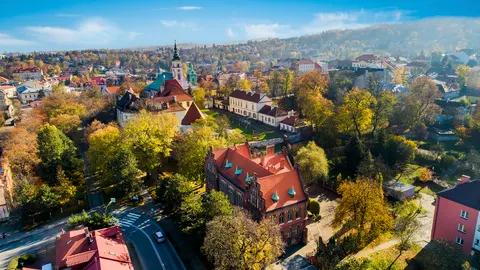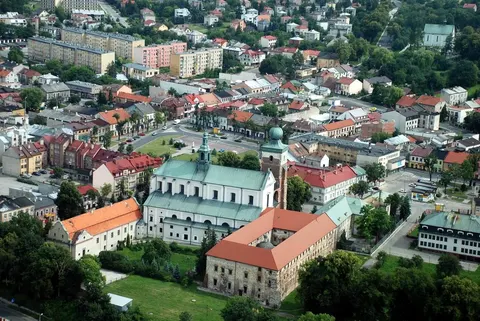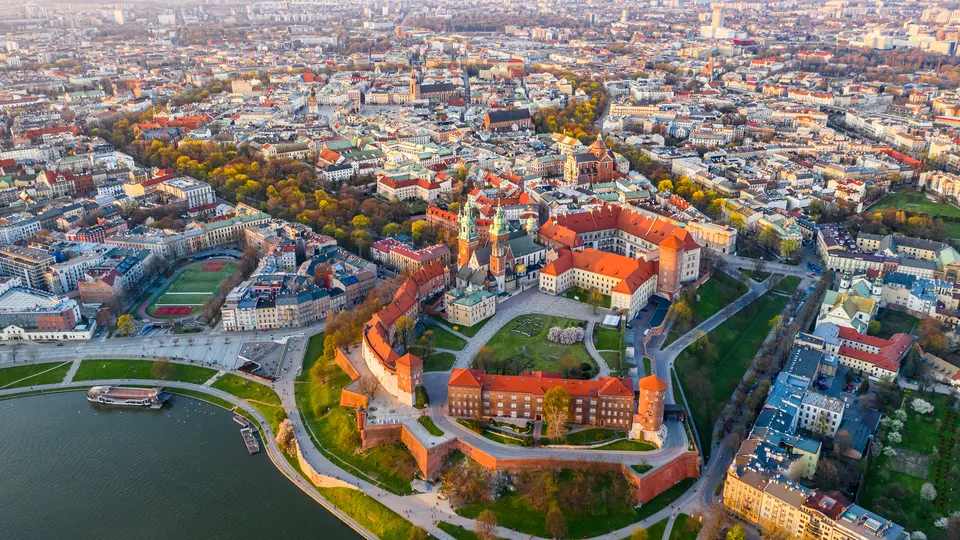

Kraków is the second-largest and one of the oldest cities in Poland, on the Vistula River in the south of the country. It was the official capital until 1596, and it remains a centre of Polish economic, academic and artistic life. Its Old Town has been a UNESCO World Heritage Site since 1978. The city began as a fortified settlement on Wawel Hill, and it later became the seat of Polish monarchs.
With about 817,000 inhabitants, Krakow lies in Lesser Poland, Poland, and is a rail hub.
Why go to Krakow?
Kraków rewards walking. The Old Town keeps its medieval street layout, and Planty Park circles the central core, so the city's monuments can be seen in historical order from the centre outward. On Wawel Hill, the cathedral and royal castle stand on the banks of the Vistula. The Main Market Square is described as the largest medieval market square in Europe, and the Cloth Hall is among its landmarks. Kazimierz, the historic Jewish quarter, has seen a boom in restaurants, bars, bookstores and souvenir shops. Jagiellonian University, one of the oldest in the world, gives the city a strong academic life.
When is the best time to visit Krakow?
Average highs range from 1 °C in January to 23 °C in July and August. May, June and September are the time for city breaks.
How do I get to Krakow without flying?
Direct bus or train services link Krakow with 35 destinations. Allowing for changes, 1,376 destinations are no more than 14 hours away without flying. Zakopane is 1h 47m away by bus with FlixBus-eu, with about 2.3 kg of CO₂ per person. The train from Warsaw with PKP Intercity takes 2h 46m; that is about 8.2 kg of CO₂ per person, 86% less than the 58 kg of a flight. From Wroclaw, it takes 3h 00m by train with PKP, with about 4 kg of CO₂ per person against 54 kg for the flight, 93% less.
What to do in Krakow
Wawel Royal Castle
The royal castle of the Polish kings, on the banks of the Vistula beside Wawel Cathedral, on the hill where the city began.
St. Mary's Basilica
One of the city's major churches, part of its heritage of Gothic, Renaissance and Baroque architecture.
Main Market Square
Described as the largest medieval market square in Europe, with the Cloth Hall among its landmarks.
Barbican
A barbican, one of the historic centre's defensive landmarks, close to St. Florian's Gate.