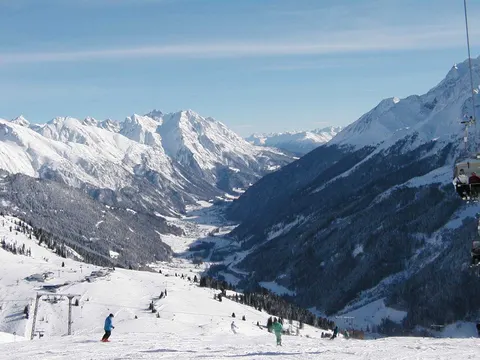
Serfaus is a municipality in the Landeck district of the Austrian state of Tyrol, on a plateau above the upper Inn valley. It is part of the ski region Serfaus-Fiss-Ladis, which the municipality formed with its neighbours Fiss and Ladis. The village is known for the U-Bahn Serfaus, a small hovertrain running underground, which allows a complete ban of cars within the town.
About 1,134 people live in Serfaus, in Tyrol, Austria.
Why go to Serfaus?
Serfaus is a village where cars are banned from the town itself, so the streets are given to walkers and the hovertrain. The U-Bahn runs about 1.3 kilometres with four stations, one of the shortest underground lines in the world. The pilgrimage church of St. Georgen was built in the Middle Ages and is one of the oldest churches in the region. Traces of a Bronze Age fireplace were found on the Komperdell, a high alpine meadow above the village. The ski area of Serfaus, Fiss and Ladis is one of the most popular holiday areas in Tyrol.
When is the best time to visit Serfaus?
Expect daytime highs of about 19 °C in July and August, falling to -2 °C in January. For skiing, go in January, February and December. If you are after nature and hiking trips, aim for June, July and August.
How do I get to Serfaus without flying?
You can get to Serfaus without changing from 3 destinations, by bus. With changes, Serfaus is within 14 hours of 2,352 destinations without flying. From Landeck, it takes 21 min by bus with altoadigemobilità, with about 0.3 kg of CO₂ per person. Travelling from Nauders, allow 26 min by bus with altoadigemobilità; that is about 0.5 kg of CO₂ per person. Feichten im Kaunertal is 1h 36m away by bus, with about 0.6 kg of CO₂ per person.
What to do in Serfaus
U-Bahn Serfaus
A small underground hovertrain with four stations on a line of about 1.3 kilometres, which keeps cars out of the town.
St. Georgen pilgrimage church
Built in the Middle Ages, one of the oldest churches in the region.
Komperdell
A high alpine meadow above the village, with the Kölnerhaus ski hut and a Bronze Age fireplace found nearby.