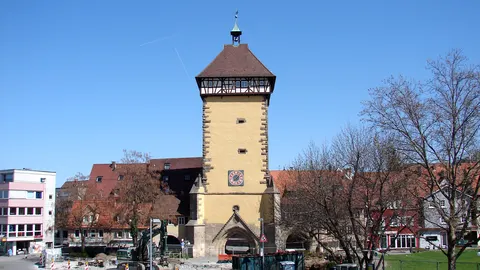
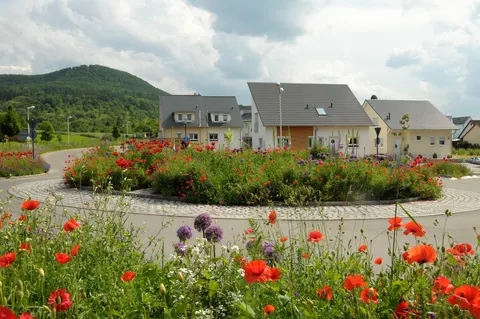
Tübingen is a university city in central Baden-Württemberg, about 30 km south of Stuttgart. Students make up almost one in three of its residents, which gives it one of the youngest profiles in Germany. The old town came through the Second World War almost intact, so its crooked lanes and half-timbered houses still line the banks of the Neckar.
Tübingen, in Baden-Wurttemberg, Germany, is home to about 92,000 people and works as a rail hub.
Why go to Tübingen?
Tübingen is worth a visit for its historic centre, one of the few in Germany that survived the war almost untouched. Narrow stair alleyways climb through the hilly terrain, and canal-side streets lead past traditional half-timbered houses. The Neckar splits in two as it reaches the old town, forming the Neckarinsel, a long island with an avenue of plane trees. In summer the island hosts concerts, plays and readings. Along the Neckarfront stands the Hölderlinturm, where the poet Friedrich Hölderlin lived out his later years. Punts called Stocherkähne still carry people along the river, and the university shapes the city's theatre companies, choirs and nightlife.
When is the best time to visit Tübingen?
In July and August the average high reaches 23 °C; in January and December it is closer to 4 °C. For city breaks, go in May, June and September.
How do I get to Tübingen without flying?
Tübingen has direct bus or train links to 10 destinations. Within 14 hours, travellers from 2,520 destinations can get here without flying. The bus from Munich with FlixBus-eu takes 3h 10m; that is about 5.2 kg of CO₂ per person, 88% less than the 44 kg of a flight. Freiburg is 2h 25m away by bus with FlixBus-eu, with about 2.9 kg of CO₂ per person. Travelling from Karlsruhe, allow 1h 36m by bus with FlixBus-eu; that is about 1.9 kg of CO₂ per person.
What to do in Tübingen
Hohentübingen Castle
The castle above the old town, now part of the university, whose history goes back to the Counts of Zollern.
St. George's Collegiate Church
A church whose clock tower offers panoramic views over the old town, and whose building was the seat of the university's collegiate church.
Rathaus
The town hall on the central market, beside the Marktplatz where the regular market days are held.
Neckarinsel
A long island in the Neckar, known for its plane tree avenue and for its summer concerts and literary readings.
Hölderlinturm
The tower house on the Neckarfront where the poet Friedrich Hölderlin spent the last years of his life, struggling with mental illness.