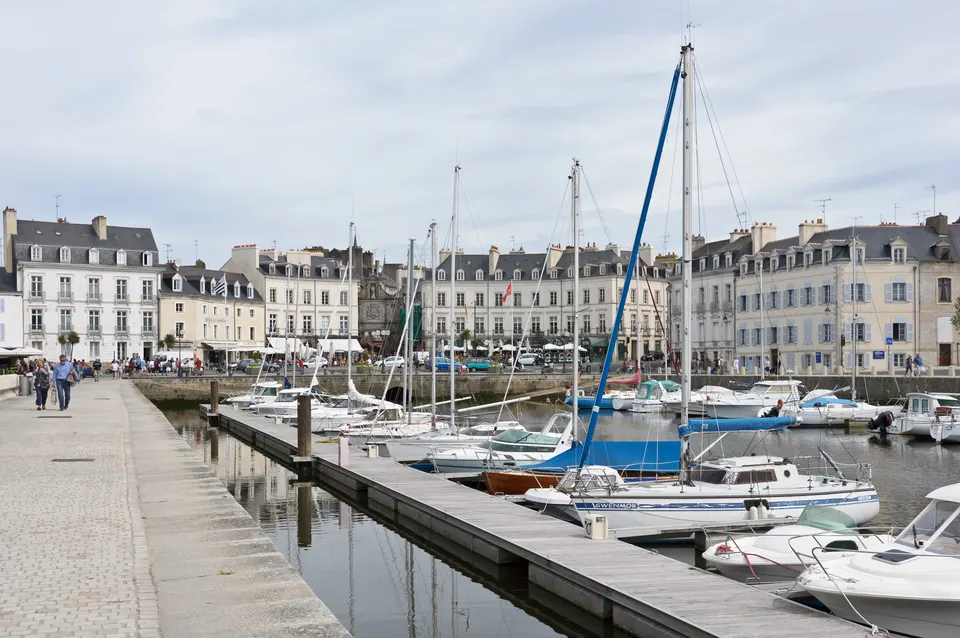

Vannes is a commune in the Morbihan department of Brittany in north-western France, on the Gulf of Morbihan at the mouth of two rivers. It was founded more than 2,000 years ago, and it is a market town with a strong link to the sea. The old town keeps timber-framed houses, medieval gates and a stretch of city walls.
About 54,000 people live in Vannes, in Brittany, France, and its station is a rail hub.
Why go to Vannes?
Vannes sits on the Gulf of Morbihan where two rivers meet the sea, and the harbour is part of its appeal. Its old town holds timber-framed houses and a run of medieval gates. The Cathedral of St Peter is a Gothic church, and the Château de l'Hermine, a former residence of the Dukes of Brittany, was turned into a palace in the 17th century. Outside the Château Gaillard stands a painted granite sculpture called Vannes and his wife, a light-hearted figure from the late Middle Ages. The Musée de la Cohue shows fine art in the town.
When is the best time to visit Vannes?
Expect daytime highs of about 22 °C in August, falling to 9 °C in January, February and December. For city breaks, any month of the year works.
How do I get to Vannes without flying?
You can get to Vannes without changing from 6 destinations, by bus or train. With changes, Vannes is within 14 hours of 1,890 destinations without flying. From Bordeaux, it takes 6h 45m by bus with BlaBlaCar Bus, with about 9.6 kg of CO₂ per person against 82 kg for the flight, 88% less. Travelling from Nantes, allow 1h 12m by train with SNCF VOYAGEURS; that is about 0.3 kg of CO₂ per person. Angers is 2h 23m away by bus with BlaBlaCar Bus, with about 4.5 kg of CO₂ per person against 38 kg for the flight, 88% less.
What to do in Vannes
Cathedral of St Peter
The town's Gothic cathedral, dedicated to St Peter.
Château Gaillard
A medieval house that now holds an archaeological museum, with a painted granite sculpture in front of it.
Château de l'Hermine
A former castle that became a palace in the 17th century, and was once a residence of the Dukes of Brittany.
Old city walls
The medieval walls, with their towers and gates, including the Tour du Connétable and the Porte Saint-Vincent.