
Vila-seca is a municipality in the Tarragonès comarca of Tarragona province in Catalonia, with about 24,000 inhabitants. It includes the urban areas of La Plana and La Pineda, and it sits beside a large petrochemical complex shared with Tarragona and La Canonja.
With about 21,000 inhabitants, Vila-seca lies in Catalonia, Spain, and is a rail hub.
Why go to Vila-seca?
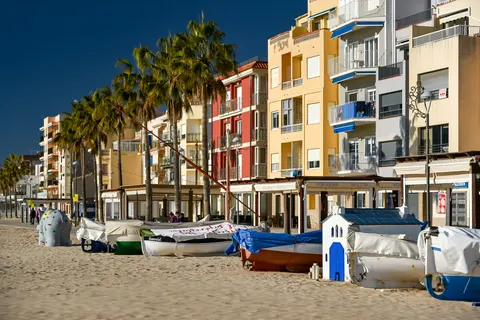
La Pineda has been revitalised with more hotels and an updated beachfront, and visitors come for the Aquopolis water park, which has dolphin and sea lion shows, and for the Pacha nightlife venue. The town has Roman-era remains, and after it became the main port, its watchtower and defence tower were built against pirate attacks. The climate is Mediterranean, with hot summers and mild winters. Reus Airport serves the area with low-cost and charter flights, and Barcelona Airport also serves it.
When is the best time to visit Vila-seca?
Average highs range from 12 °C in January to 28 °C in July and August. June, July and September are the time for beach holidays.
How do I get to Vila-seca without flying?
Direct train services link Vila-seca with 3 destinations. Allowing for changes, 1,400 destinations are no more than 14 hours away without flying. Tarragona is 8 min away by train with RENFE OPERADORA, with about 0.1 kg of CO₂ per person. The train from Reus with RENFE OPERADORA takes 9 min; that is about 0.1 kg of CO₂ per person. From Cambrils, it takes 10 min by train with RENFE OPERADORA, with about 0.1 kg of CO₂ per person.
What to do in Vila-seca
Aquopolis water park
A water park with dolphin and sea lion exhibitions, one of the main attractions of La Pineda.
Watchtower and defence tower
Built to protect the town from corsair attacks when it became the main port.