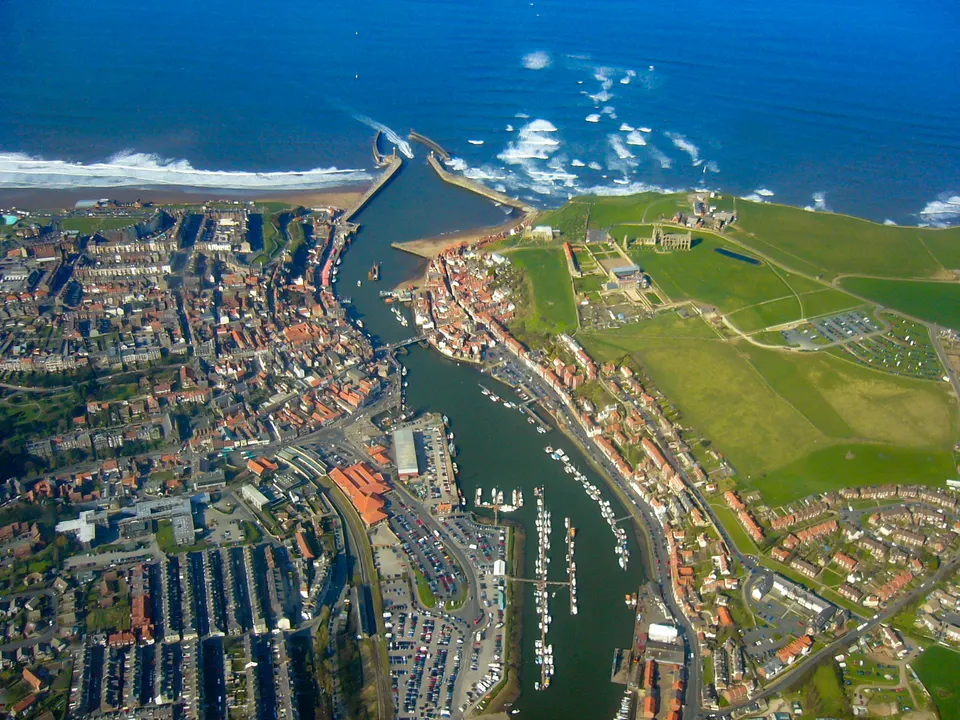

Whitby is a seaside town and port at the mouth of the River Esk, on the North Yorkshire coast where the North York Moors meet the sea. Its economy grew from herring and whaling, alum mining and Whitby jet jewellery, and tourism followed in the Georgian period. It was also where Captain Cook learned seamanship.
With about 13,000 inhabitants, Whitby lies in England, United Kingdom.
Why go to Whitby?
Whitby is a harbour town of steep streets, with the abbey ruin on the East Cliff as its most prominent landmark. The swing bridge over the Esk divides the upper and lower harbours and joins the two halves of the town. The West Pier lighthouse, built in 1831, is the taller of the two lighthouses guarding the harbour. Captain Cook is commemorated by a statue on the West Cliff, and a whale bone arch recalls the whaling industry. The town has featured in literary works, including Bram Stoker's Dracula, and the Bram Stoker Film Festival takes place here each October.
When is the best time to visit Whitby?
Average highs range from 7 °C in January and February to 17 °C in August. July, August and September are the time for nature and hiking trips. For city breaks, any month of the year works.
How do I get to Whitby without flying?
There are no direct train, bus or ferry links to Whitby yet. The trip planner can still look for a route with changes.
What to do in Whitby
Whitby Abbey
The abbey ruin at the top of the East Cliff, owned by English Heritage and the town's most prominent landmark.
Swing bridge
The electric swing bridge over the River Esk, which divides the upper and lower harbours and joins the two sides of the town.
St Mary's Church
A grade I listed church on the east bank, on the site of a Saxon church, reached by the 199 steps of the Church Stairs.
Captain Cook statue
A statue of Captain James Cook on the West Cliff, marking his apprenticeship in the town.
Whitby Museum
A museum with Frank Meadow Sutcliffe's photographic archive and a collection on the history of jet.