By Thomas AxelssonPublished Updated 4 min read
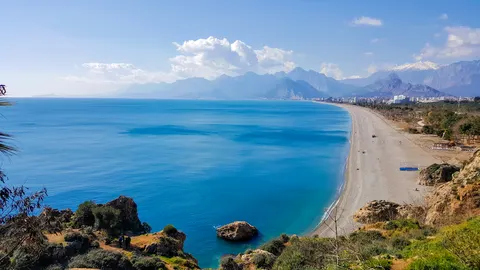
May is when beach season starts to open up, and 555 destinations in Sustainate's route data fall in the sun and beach band for the month. Eight of them are covered here, with May highs from 22 °C at three of the group up to 26 °C at Antalya. The full list is on the beach in May page.
Where can you go for beach trips by train in May?
The table lists each destination's May high and its number of direct links. Those links are a mix of bus, ferry and train, so the sections below take each mode in turn.
| Destination | May high | direct links |
|---|---|---|
| Huelva, Spain | 25 °C | 4 |
| Antalya, Turkey | 26 °C | 11 |
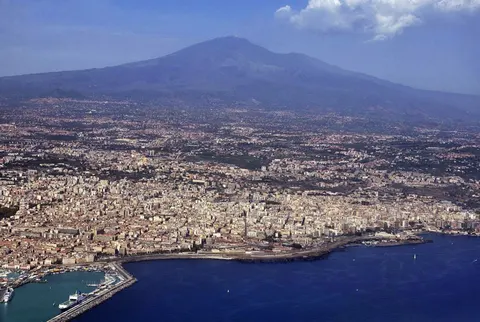
| Catania, Italy | 24 °C | 8 |
| Valencia, Spain | 22 °C | 13 |
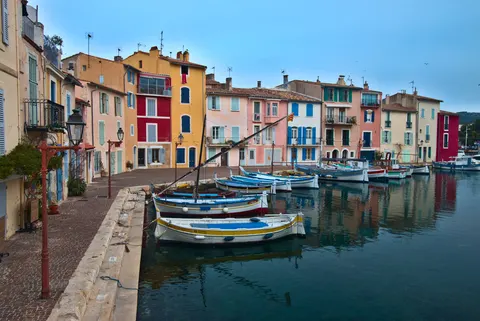
| Martigues, France | 22 °C | 2 |
| Vitrolles, France | 22 °C | 4 |
| Brindisi, Italy | 23 °C | 10 |
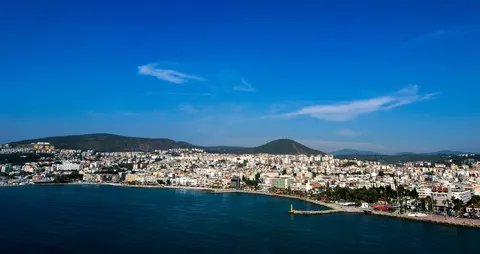
| Kuşadası, Turkey | 25 °C | 6 |
Valencia has the most links, 13, and several of them are fast trains to Madrid, Barcelona and Alicante. Antalya has 11, and the ones listed are buses. Martigues has just two, both short rail hops, so the whole trip depends on that one line. Huelva has four, split between bus and train.
What is the weather like in May?
May highs run from 22 °C at Valencia, Martigues and Vitrolles through 23 °C at Brindisi and 24 °C at Catania to 25 °C at Huelva and Kuşadası, and 26 °C at Antalya. That makes May a warm month rather than a hot one, which suits anyone who prefers warm to hot and would rather arrive before the summer peak.
The warm stretch builds from here into summer. Antalya's warmest months are July and August, at 35 °C, and Huelva and Kuşadası both reach 33 °C then. Catania tops out at 32 °C, Brindisi at 30 °C, and Valencia, Martigues and Vitrolles at 29 °C. Winter is a different story: the coldest high is 10 °C at Vitrolles and 11 °C at Martigues, against 15 °C at Huelva. May sits comfortably between those extremes.
Which of these places is easiest to reach by train?
Vitrolles is the best connected of the eight, with 743 destinations within eight hours and 1,999 within fourteen. Its trains reach Rognac in 3 minutes, Marseille in 14 minutes and Arles in 38 minutes.
Martigues comes next, with 524 destinations within eight hours and 1,846 within fourteen. Its two links are short rail hops: Port-de-Bouc in 3 minutes and Sausset-les-Pins in 13 minutes.
Valencia reaches 187 destinations within eight hours and 1,045 within fourteen. Alicante is 1h 55m away by train, Madrid 2h 00m and Barcelona 3h 00m, which makes it a practical base for a longer coastal trip. Brindisi is more local in character. Its train to Lecce takes 20 minutes, and the bus to Polignano a Mare takes 1h 04m, but only 139 destinations lie within eight hours.
Antalya has the thinnest reach of the group, with 33 destinations within eight hours and 76 within fourteen. Buses run to Belek in 48 minutes and to Kemer in 1h 00m, and the bus to Ankara takes 7h 00m. Kuşadası is similar, at 38 destinations within eight hours. Huelva reaches 131 destinations within eight hours. Its train to Cordoba takes 2h 00m, and buses reach Seville in 1h 04m and Faro in 1h 25m.
How much CO₂ does going by train save?
Against a flight, the savings here are striking. Valencia to Madrid by train emits 2.9 kg of CO₂ against 69 kg, a saving of 96%, and Huelva to Cordoba emits 1.9 kg against 47 kg, also 96%. Valencia to Barcelona emits 5 kg against 70 kg, saving 93%.
The short train legs barely register. Martigues to Port-de-Bouc and Sausset-les-Pins both show 0 kg of CO₂, Vitrolles to Rognac shows 0 kg, and Vitrolles to Marseille and Arles emit 0.1 kg each. Brindisi to Lecce emits 0.5 kg over 37 km.
Buses carry a little more, though still very little next to a flight. Catania to Palermo covers 166 km and emits 4.5 kg of CO₂ against 38 kg, a saving of 88%. Brindisi to Naples covers 310 km and emits 8.4 kg against 71 kg, also 88%. The Kuşadası to Ayvalık bus emits 4.6 kg against 39 kg, and Antalya to Ankara emits 12 kg against 88 kg, saving 86%.
What else is worth knowing before you go?
Some of these legs are long days in their own right. The Antalya to Ankara bus takes 7h 00m, and Brindisi to Naples takes 4h 56m. The Kuşadası to Ayvalık bus takes 4h 00m, while the Kuşadası to Söke bus takes only 30 minutes and emits 0.5 kg, and Selçuk is 20 minutes away.
Catania mixes modes. The ferry to Valletta with Virtu Ferries takes 4h 30m and emits 8 kg of CO₂ against 24 kg for the flight, a saving of 67%, the smallest of the comparisons here. Syracuse is 1h 00m away by bus.
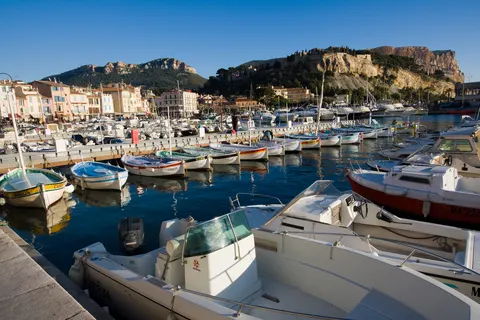
Martigues has only two links, and the longest takes 13 minutes, so nearby towns are easy by rail even though the wider reach comes from the Marseille network behind them. Antalya's listed links are buses, so check the times for your date before you build the rest of the trip around them.
Check the times for your date before you travel, and allow time for any change on a route with more than one leg. The details here come from Sustainate's route data and may differ from the live timetable on the day.