By Thomas AxelssonPublished Updated 5 min read
You can get around Poland without flying: 224 of its 289 destinations are connected to the route network. Berlin to Warsaw takes 6h 00m with no transfer and emits 7 kg of CO₂, against 66 kg for the flight.
How do you get around Poland without flying?
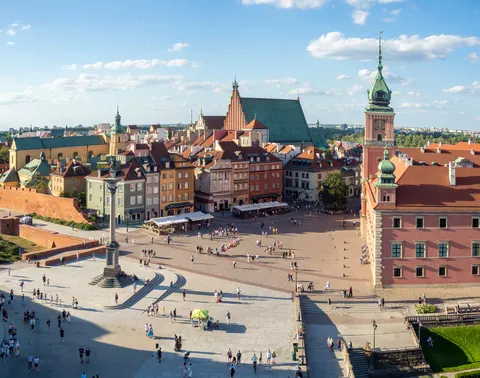
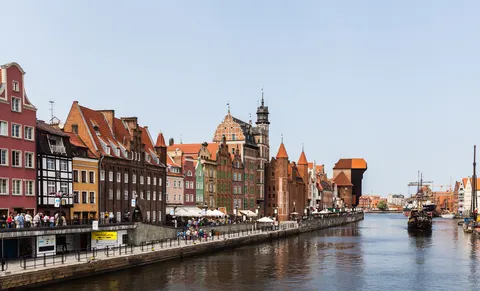
Around the big cities, the trains are frequent enough to treat as commuter hops. Warsaw to Gdansk takes 2h 25m by PKP Intercity and emits 9.2 kg of CO₂ over 284 km, against 65 kg for the flight, a saving of 86%. Wroclaw to Berlin takes 4h 00m by PKP/DB at 5 kg, against 38 kg by air.
Shorter hops go by bus or short train rides. Gdansk to Gdynia is 30 minutes by FlixBus-eu, at 0.5 kg for 20 km, and Gdansk to Torun takes 2h 05m at 4 kg for 149 km. On the coast, Szczecin to Świnoujście takes 1h 12m by PKP Intercity at 1.9 kg, and Szczecin to Stargard takes 24 minutes at 1.1 kg.
Poland has 509 domestic routes and 118 international ones in Sustainate's route data. Each change adds time, so leave slack at every connection and check the times for your date before you set off. The figures here are journey times, not timetables.
How many direct links do the big cities in Poland have?
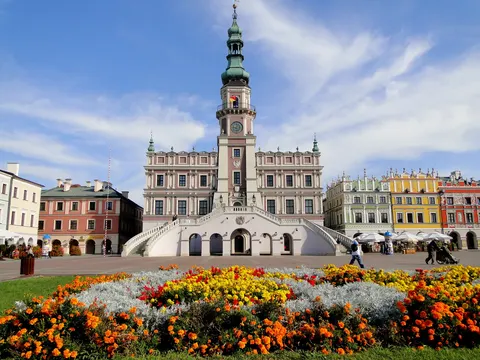
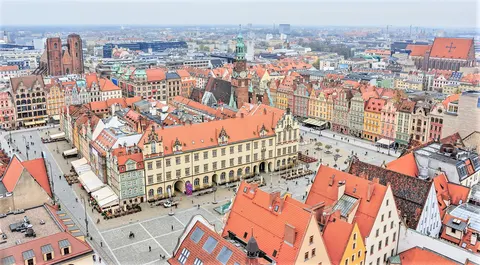
Wroclaw leads this guide with 36 direct links, followed by Warsaw with 33. Gdansk and Szczecin each have 14, Zakopane has 6 and Zamość has 2.
The links show where each place leads. From Gdansk you can take the train to Warsaw in 2h 25m or the bus to Torun in 2h 05m. Zakopane reaches Krakow by FlixBus-eu in 1h 47m, Nowy Targ by PKP Intercity train in 14 minutes, and Rabka-Zdrój by bus in 55 minutes. Zamość has just two links, a 22-minute PKP Intercity train to Szczebrzeszyn and an 88-minute FlixBus-eu bus to Lublin.
Reach tells you how far a day can take you. From Warsaw, 356 destinations lie within 8 hours and 1,314 within 14 hours. Wroclaw reaches 551 and 1,895, and Szczecin reaches 534 and 1,983. Gdansk reaches 210 and 922, Zakopane 338 and 953, and Zamość 190 and 642. The smaller towns show how thin the network is near the eastern and southern edges.
Which trips cross the border from Poland?
Poland links with Austria, the Czech Republic, Germany, Lithuania, Slovakia and Sweden. These crossings start from the cities in this post.
- Wroclaw to Berlin: a 240-minute train on PKP/DB, emitting 5 kg of CO₂ against 38 kg for the flight, a saving of 87%.
- Szczecin to Berlin: a 119-minute FlixBus-eu bus, emitting 3.4 kg over 127 km.
- Warsaw to Prague: an 8-hour train on PKP/CD, emitting 10 kg against 66 kg for the flight, a saving of 85%.
- Wroclaw to Prague: a 241-minute FlixBus-eu coach over 217 km, emitting 5.9 kg against 28 kg, a saving of 79%.
- Wroclaw to Hamburg: a 512-minute FlixBus-eu coach over 550 km, emitting 15 kg against 70 kg, a saving of 79%.
- Stockholm to Szczecin: 14h 27m, emitting 19 kg against 88 kg, a saving of 78%.
The Hamburg crossing is a long bus day, so treat it as a full trip rather than a short hop. Prague to Gdansk takes 10h 45m at 19 kg against 71 kg by air, and Budapest to Gdansk takes 13h 24m at 27 kg against 98 kg, savings of 73% and 72% that are smaller than elsewhere because the journey is long.
When should you go to Poland?
Each kind of trip has its own season. Snow & Ski peaks in January, with 25 destinations, City & Culture in May, with 47, and Nature & Hiking in June, with 67.
Most cities are at their best for sightseeing in May. Warsaw and Wroclaw reach 19 °C that month, and Szczecin and Zamość peak at 18 °C. Gdansk is the exception, with its City & Culture peak in June at 19 °C. Zakopane is the mountain case: its Snow & Ski peak is January at -2 °C, and its hiking and culture peak is July at 19 °C.
Summer is the warmest season. Warsaw's warmest months are July and August at 23 °C, and Wroclaw reaches 24 °C in July. Szczecin reaches 23 °C in July, while Gdansk gets to 22 °C in July and August. In January Warsaw averages 0 °C, Gdansk 1 °C and Wroclaw and Szczecin 2 °C, so a winter city break calls for warmer clothes than a May one.
How much CO₂ does going by train save?
From London, the train to Warsaw takes 15h 52m with three transfers, on Eurostar, DB, DB Fernverkehr AG and PKP/DB. It emits 22 kg of CO₂ against 185 kg for the flight, saving 163 kg, or 88%. The night option takes 19h 55m and emits 19 kg, which is 4h 03m longer. London to Wroclaw takes 12h 46m with four transfers, on Eurostar, DB and PKP Intercity, and emits 19 kg against 152 kg, a saving of 88%.
Other long hauls save just as much. Paris to Warsaw takes 14h 35m and emits 19 kg, against 175 kg by air, saving 89%. London to Lodz takes 15h 17m at 23 kg against 172 kg, saving 87%, and London to Poznan takes 12h 22m at 18 kg against 150 kg, saving 88%. Paris to Wroclaw takes 11h 29m at 17 kg against 138 kg.
Shorter pairs save less in absolute terms but still cut the figure sharply. Warsaw to Szczecin takes 5h 16m and emits 16 kg against 104 kg for the flight, a saving of 85%.
Is the train faster than flying door to door?
For Berlin to Warsaw, it is close. The flight takes 5h 12m door to door once airport time is counted, while the train takes 6h 00m, so the train is 48 minutes slower. The London routes are further behind: London to Warsaw is 9h 24m slower by train than by air, and London to Wroclaw is 6h 39m slower.
To see what the flight figures include and how the train figures are built, read how Sustainate calculates CO₂.