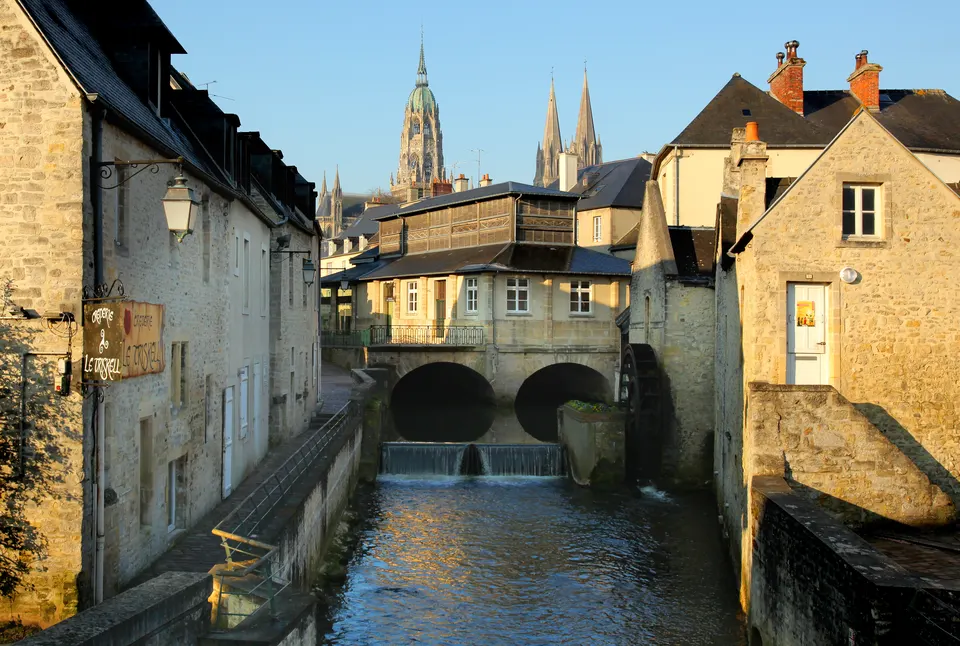

Bayeux is a town in the Calvados department of Normandy, in northwestern France, about 7 kilometres from the English Channel coast. The river Aure runs through it. Bayeux is the home of the Bayeux Tapestry, which depicts the events leading up to the Norman Conquest of England in 1066. It was also the first major town the Allies secured during Operation Overlord after D-Day.
Bayeux, in Normandy, France, is home to about 16,000 people.
Why go to Bayeux?
Bayeux is best known for the Bayeux Tapestry, made to commemorate the Norman Conquest of England. Tradition credits its making to attendants of Matilda of Flanders, though its English spellings suggest it was stitched in England. The Cathédrale Notre-Dame de Bayeux, a Norman-Romanesque and Gothic church, is probably the tapestry's original home. The town also has a botanical garden, and the Aure, which flows through the centre, offers views from several points. Charles de Gaulle made two famous speeches here. Bayeux is also the capital of the Bessin, the area that extends north-west of Calvados.
When is the best time to visit Bayeux?
In July and August the average high reaches 21 °C; in January, February and December it is closer to 8 °C.
How do I get to Bayeux without flying?
Bayeux has direct train links to 2 destinations. Within 14 hours, travellers from 1,935 destinations can get here without flying. The train from Rennes with SNCF VOYAGEURS takes 2h 56m; that is about 0.4 kg of CO₂ per person. Caen is 15 min away by train with SNCF VOYAGEURS, with about 0.1 kg of CO₂ per person.
What to do in Bayeux
Bayeux Tapestry
Displayed in a museum in the town centre, it depicts the events leading to the Norman Conquest of England.
Cathédrale Notre-Dame de Bayeux
A Norman-Romanesque and Gothic cathedral, consecrated in 1077.
Jardin botanique de Bayeux
A local botanical garden dating from 1864.