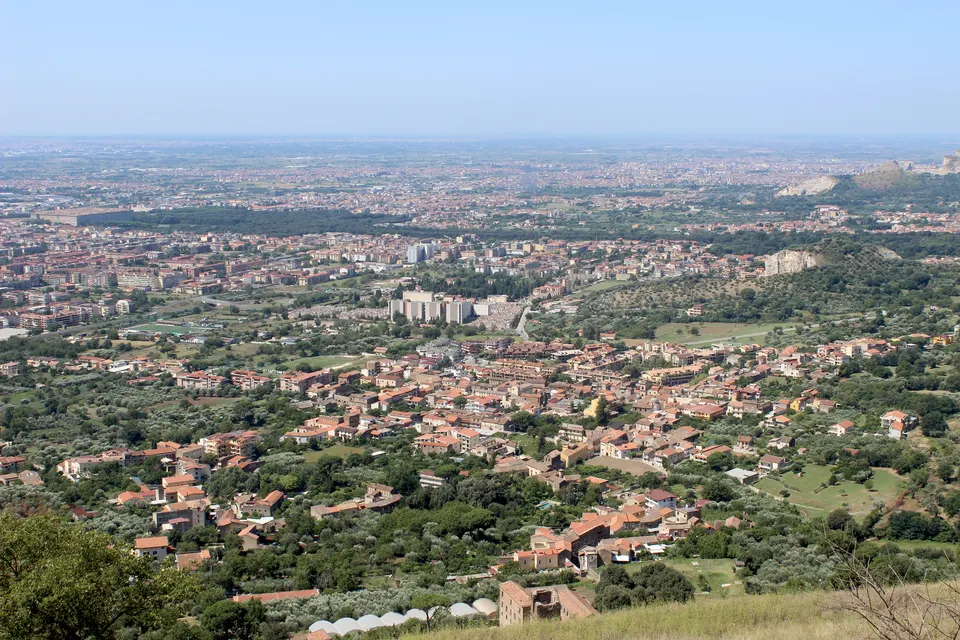

Caserta is the capital of its province in the Campania region of southern Italy, about 36 km north of Naples. It is an agricultural, commercial and industrial city on the edge of the Campanian plain, at the foot of a mountain range. Its best-known landmark is the 18th-century Bourbon Royal Palace. The older town of Casertavecchia, once a bishopric seat, came before the modern city.
With about 73,000 inhabitants, Caserta lies in Campania, Italy.
Why go to Caserta?
The Royal Palace, called the Reggia, was designed in the eighteenth century by Luigi Vanvitelli, with a plan that recalls Versailles. It was built as a residence for the Bourbon kings of Naples and Sicily, and it is one of the most visited monuments in Italy. Its many rooms are decorated in different styles, and the palace has served as a film set for several well-known movies. Behind it stretches a long park with waterfalls, lakes and a famous English garden. The palace is a UNESCO World Heritage Site, and the Palazzo Vecchio and the Vanvitelli Aqueduct add to the historic sights in town.
When is the best time to visit Caserta?
Average highs range from 11 °C in January to 29 °C in July and August. For city breaks, any month of the year works.
How do I get to Caserta without flying?
Direct bus services link Caserta with 5 destinations. Allowing for changes, 1,236 destinations are no more than 14 hours away without flying. Rome is 2h 20m away by bus with FlixBus-eu, with about 4.8 kg of CO₂ per person against 41 kg for the flight, 88% less. The bus from Modena with FlixBus-eu takes 8h 01m; that is about 13 kg of CO₂ per person, 88% less than the 111 kg of a flight. From Naples, it takes 31 min by bus with FlixBus-eu, with about 0.7 kg of CO₂ per person.
What to do in Caserta
Royal Palace of Caserta
The Bourbon palace, designed by Luigi Vanvitelli with a plan that recalls Versailles. Its rooms are decorated in many different styles.
Park of the Royal Palace
The long park behind the palace, with waterfalls, lakes and a famous English garden.
Palazzo Vecchio
A fourteenth-century building that Vanvitelli renovated as a temporary residence for the royal court.
Aqueduct of Vanvitelli
An eighteenth-century aqueduct that carries the name of Luigi Vanvitelli, the architect of the royal palace.