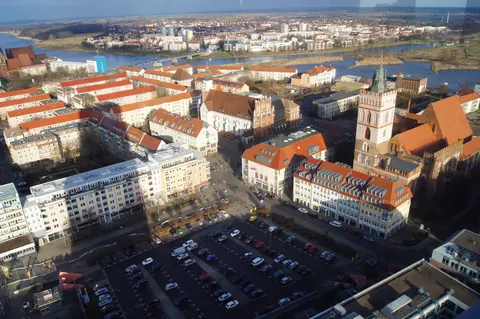
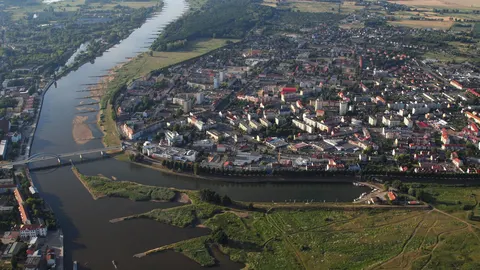
Cottbus is a university city and the second-largest city in the German state of Brandenburg, after Potsdam. With around 100,000 inhabitants, it is the most populous city in Lusatia. The city lies in the Sorbian settlement area, on the shore of Germany's largest artificial lake, the Cottbuser Ostsee. It is the largest bilingual city in Germany.
Cottbus, in Brandenburg, Germany, is home to about 85,000 people and works as a rail hub.
Why go to Cottbus?
Cottbus is bilingual. Signage is mostly in German and Lower Sorbian, and the city hosts Lower Sorbian institutions such as the Lower Sorbian Gymnasium and a Sorbian broadcaster. The Wendish Quarter is built to resemble traditional Sorbian architecture, and the Wendish Museum shows the culture and history of the Wends of Lower Lusatia. Branitz Castle, a residence of Prince Pückler-Muskau, lies in the south-east of the city beside Branitz Park, which has two grass pyramids. The Brandenburg University of Technology is based here.
When is the best time to visit Cottbus?
In July the average high reaches 24 °C; in January and December it is closer to 3 °C.
How do I get to Cottbus without flying?
Cottbus has direct bus or train links to 7 destinations. Within 14 hours, travellers from 2,182 destinations can get here without flying. The train from Berlin with DB Fernverkehr AG takes 1h 14m; that is about 1.9 kg of CO₂ per person. Hamburg is 5h 12m away by bus with FlixBus-eu, with about 9.6 kg of CO₂ per person against 81 kg for the flight, 88% less. Travelling from Leipzig, allow 1h 43m by train with DB Regio AG Nordost; that is about 2.5 kg of CO₂ per person.
What to do in Cottbus
Branitz Park
A large park on the Spree, designed by Prince Pückler-Muskau, with two grass pyramids.
Branitz Castle
The palace where Prince Pückler-Muskau lived, now a museum about the park and its creator.
Wendish Museum
A museum of the culture and history of the Wends of Lower Lusatia, with traditional costumes and customs.
Dieselkraftwerk Art Museum
Paintings, sculpture, graphics and photography, focused on landscape, nature and the environment.