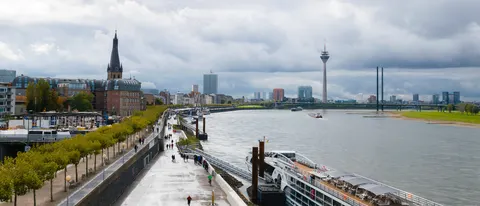
Essen is the central city of the Ruhr, the largest urban area in Germany, and after Dortmund the second-largest city of the region. It is the fourth-largest city in North Rhine-Westphalia and the seat of the Roman Catholic Diocese of Essen, often called the diocese of the Ruhr. Essen is also often called the energy capital of Germany, with two of the country's largest energy providers headquartered here.
Essen is in North Rhine-Westphalia, Germany, and has a population of about 593,000; it is also a rail hub.
Why go to Essen?
Essen's story is one of industrial change. The Zollverein Coal Mine Industrial Complex, once the largest of its kind in Europe, closed in the early 1990s and is now a UNESCO World Heritage Site. The city's industrial past is set against a strong service economy, and it is known for the Folkwang University of the Arts and the Red Dot industrial design award. It has held the European Capital of Culture title on behalf of the whole Ruhr area and was chosen as European Green Capital. Its roots reach back to a medieval abbey.
When is the best time to visit Essen?
July and August are the warmest, with highs of about 22 °C, and January and December are the coolest, at about 5 °C. Any month suits city breaks.
How do I get to Essen without flying?
From 15 destinations you can travel to Essen directly by bus or train. Counting connections, 2,446 destinations can reach it within 14 hours without flying. Travelling from Cologne, allow 57 min by train with DB Fernverkehr AG; that is about 1 kg of CO₂ per person. From Dusseldorf, it takes 26 min by train with DB Fernverkehr AG, with about 0.5 kg of CO₂ per person. The train from Wurzburg with ÖBB takes 4h 56m; that is about 4.9 kg of CO₂ per person, 92% less than the 64 kg of a flight.
What to do in Essen
Zollverein Coal Mine Industrial Complex
Once the largest coal mine of its kind in Europe, now a UNESCO World Heritage Site.
Find tours and tickets: Zollverein Coal Mine Industrial Complex
Alteburg castle
A castle in the south of the city that dates back to the early Middle Ages.
Herrenburg
An early medieval castle nearby, in the same part of the city as the Alteburg.
Lake Baldeney
One of the reservoirs formed by damming the Ruhr through Essen.
Chest of Stone
A megalithic tomb from around the early Bronze Age, called Essen's earliest preserved example of architecture.