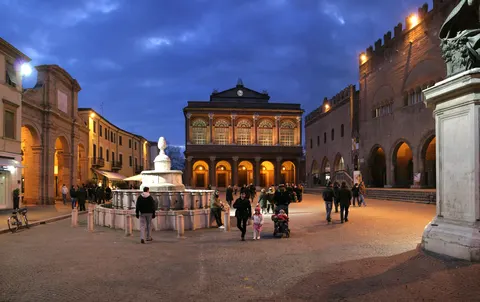
Forlì is a city in the Emilia-Romagna region of northern Italy. Together with Cesena, it is the capital of the province of Forlì-Cesena, and its population was 118,053 in 2026. The city has ancient Roman origins and lies on the south-eastern edge of the Po Valley, between the alluvial plain and the northern Apennines, along the ancient Via Emilia.
Forli, in Emilia-Romagna, Italy, is home to about 117,000 people and works as a rail hub.
Why go to Forli?
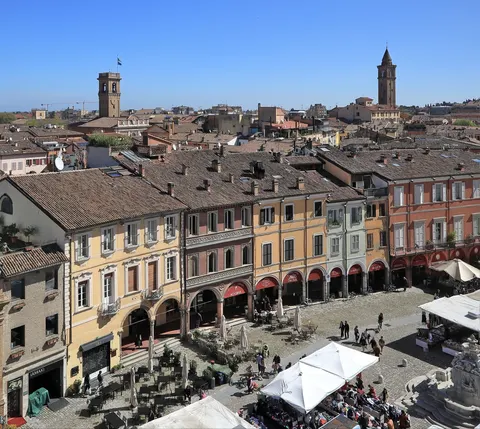
Forlì's historic centre holds buildings from the Middle Ages, the Renaissance, the Baroque and the Fascist period. The San Domenico museum complex grew out of a Dominican convent and houses the Civic Art Gallery, with works by Beato Angelico, Lorenzo di Credi, Marco Palmezzano and Antonio Canova. The Verzocchi Collection holds paintings on the theme of work in Italian art of the 20th century. In the 1930s the area between the railway station and the centre was redesigned in rationalist style around Viale della Libertà and Piazzale della Vittoria. The city is also a university centre through the Forlì Campus of the University of Bologna.
When is the best time to visit Forli?
In July the average high reaches 31 °C; in January it is closer to 9 °C.
How do I get to Forli without flying?
Forli has direct bus or train links to 2 destinations. Within 14 hours, travellers from 1,958 destinations can get here without flying. The train from Bologna with altoadigemobilità takes 37 min; that is about 0.8 kg of CO₂ per person. Rimini is 45 min away by bus with FlixBus-eu, with about 1.2 kg of CO₂ per person.
What to do in Forli
Museo Civico San Domenico
A former Dominican convent that now holds the Civic Art Gallery and hosts major temporary exhibitions.
Palazzo Romagnoli
A palace that houses its own collections, including work from the 20th century.
Piazzale della Vittoria
A square in the rationalist quarter, lined with schools and administrative buildings from the 1930s.
Casa Museo Villa Saffi
A house museum, one of the municipal museums of the city.