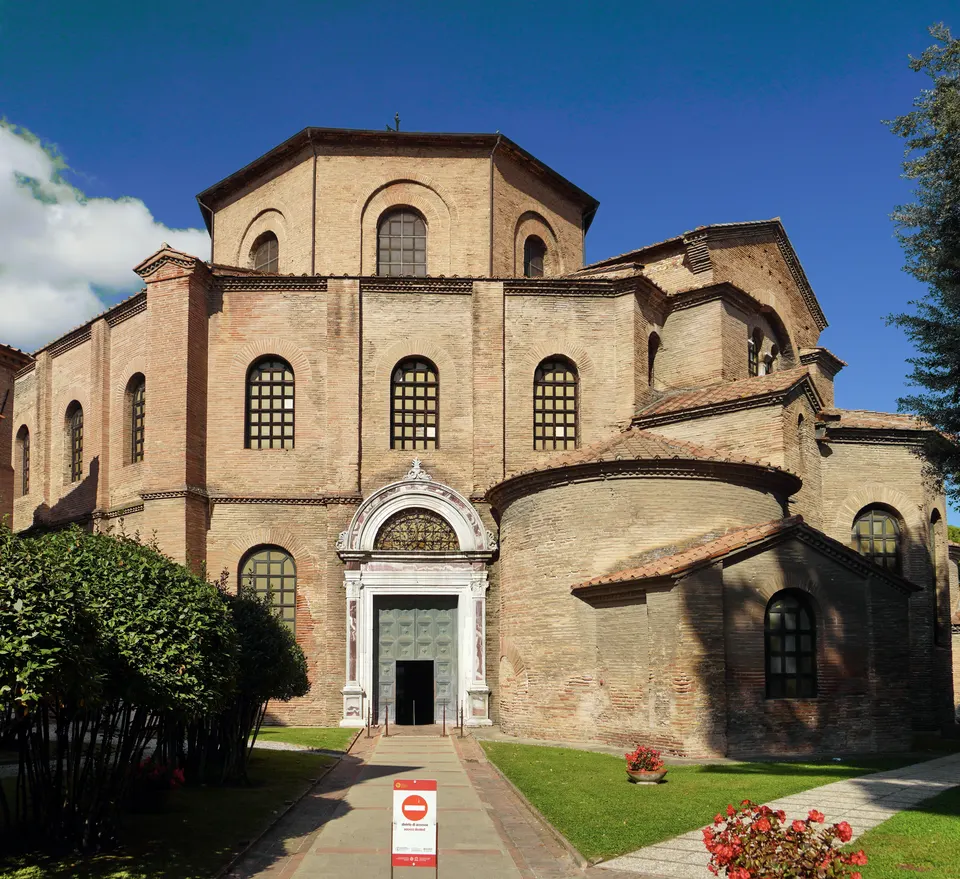

Ravenna is the capital of its province in the Emilia-Romagna region of northern Italy, though it lies inland. It was the capital of the Western Roman Empire in the fifth century, and later of the Ostrogothic Kingdom and the Byzantine Exarchate. A canal links the city to the Adriatic Sea. It is known for its late Roman and Byzantine architecture and its mosaics, which have made it a centre for mosaic workshops and schools.
About 81,000 people live in Ravenna, in Emilia-Romagna, Italy, and its station is a rail hub.
Why go to Ravenna?
The main draw is a group of early Christian buildings listed as a UNESCO World Heritage Site. The Mausoleum of Galla Placidia and the Basilica of San Vitale are among them, and its concentration of mosaics has earned the city the nickname capital of mosaics. Dante Alighieri was buried here: the Basilica of San Francesco held his funeral in 1321, and the poet's tomb is annexed to the church. The Rocca Brancaleone, a castle built by the Venetians in the 15th century, is now a public park.
When is the best time to visit Ravenna?
Expect daytime highs of about 29 °C in July and August, falling to 8 °C in January. For city breaks, any month of the year works.
How do I get to Ravenna without flying?
You can get to Ravenna without changing from 3 destinations, by bus or train. With changes, Ravenna is within 14 hours of 1,792 destinations without flying. From Bologna, it takes 1h 12m by train with Trenitalia, with about 1 kg of CO₂ per person. Travelling from Padua, allow 2h 45m by bus with FlixBus-eu; that is about 3.1 kg of CO₂ per person. Rimini is 1h 10m away by bus with FlixBus-eu, with about 1.3 kg of CO₂ per person.
What to do in Ravenna
Mausoleum of Galla Placidia
An early Christian mausoleum from the fifth century, one of the eight early Christian buildings on the UNESCO list.
Basilica of San Vitale
A sixth-century basilica and one of the Byzantine buildings in the UNESCO group, dating from 548.
Basilica of San Francesco
Rebuilt in the 10th and 11th centuries over an older church, it holds the tomb of Dante Alighieri.
Rocca Brancaleone
A Venetian castle from the 15th century, once part of the city walls and now a public park.