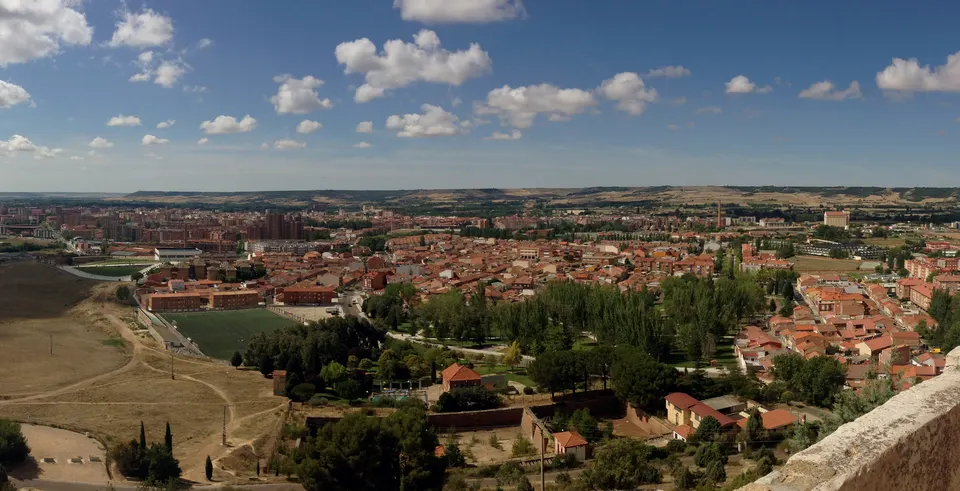

Palencia is a city in the autonomous community of Castile and León, in northern Spain. It is the capital and largest municipality of the province of the same name, and it lies in the northern half of the Inner Plateau, on the left bank of the Carrión river. The city is about 40 km north of Valladolid and about 190 km north of Madrid. The modern suburbs spread across the river on the right bank, while the old city stands on the left.
About 79,000 people live in Palencia, in Castille and León, Spain, and its station is a rail hub.
Why go to Palencia?
Palencia rewards visitors who like Roman, medieval and Gothic layers in one town. La Olmeda Roman Villa, a 4th-century house, is best known for its mosaics, which show great mythological scenes. The flamboyant Gothic Cathedral, dedicated to San Antolín, stands over a Visigothic crypt, and its museum holds a retablo by Juan de Flandes, court painter to Queen Isabella of Castile. The Calle Mayor, a pedestrian street about 900 metres long, is lined with architecture of several periods. A basilica at Baños de Cerrato, a short way south of the city, is the oldest church on the peninsula.
When is the best time to visit Palencia?
Expect daytime highs of about 28 °C in July and August, falling to 8 °C in January and December. For city breaks, any month of the year works.
How do I get to Palencia without flying?
You can get to Palencia without changing from 5 destinations, by train. With changes, Palencia is within 14 hours of 704 destinations without flying. From Vitoria-Gasteiz, it takes 2h 58m by train with RENFE OPERADORA, with about 1.7 kg of CO₂ per person against 41 kg for the flight, 96% less. Travelling from Valladolid, allow 22 min by train with RENFE OPERADORA; that is about 0.4 kg of CO₂ per person. León is 35 min away by train with RENFE OPERADORA, with about 1 kg of CO₂ per person.
What to do in Palencia
Cristo del Otero
A statue of Christ on the hill to the north-east of the city, the tallest of its kind in Spain.
La Olmeda Roman Villa
A well-preserved Roman house, best known for its mosaics of mythological scenes, with thermal baths and burial sites nearby.
Cathedral of San Antolín
A flamboyant Gothic cathedral built over a low Visigothic crypt, with a retablo of twelve panels by Juan de Flandes.
Calle Mayor
A long pedestrian High Street where the architecture of several centuries stands side by side.