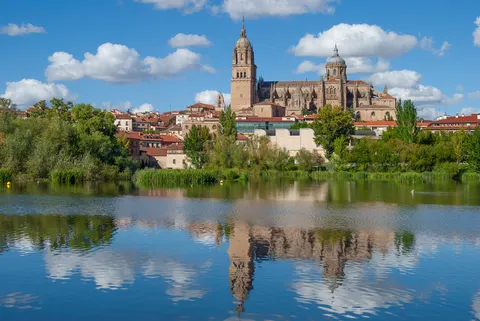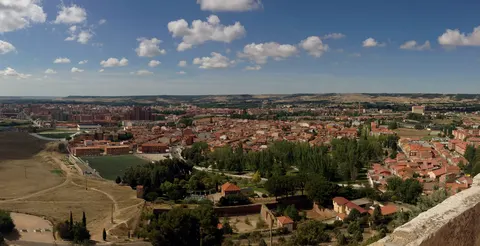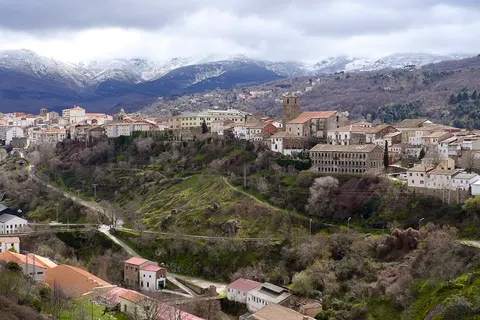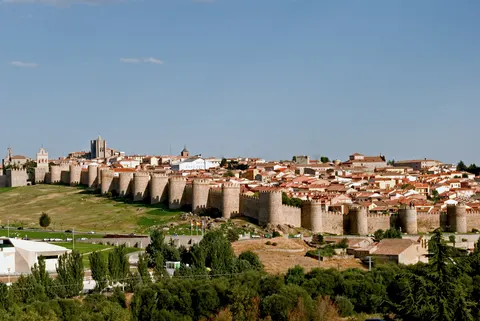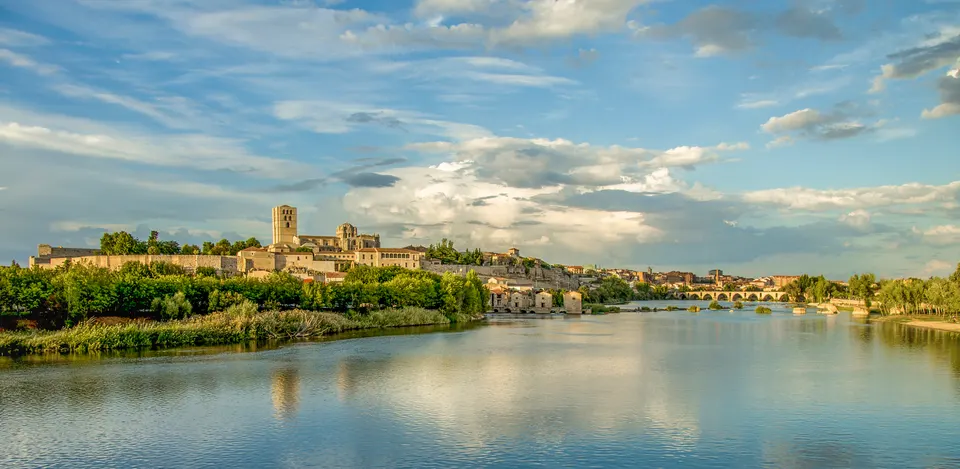

Zamora straddles the Duero river, and its old churches and castle give the streets a dense, layered look. It is the capital of its province in the Castile and León region of Spain, and the churches of the old town are the first thing many visitors notice on arrival. The river runs through the middle of the town, and the walk between the churches takes in both banks.
Zamora is in Castille and León, Spain, and has a population of about 62,000; it is also a rail hub.
Why go to Zamora?
Zamora is a city of Romanesque churches, and the walk between them is the main reason to come. The Cathedral of Zamora and the Castle of Zamora anchor the old town. The Church of Santa María Magdalena, the Church of Saint Isidore, the Church of Santiago de los Caballeros, the Church of San Cipriano and the Church of San Claudio de Olivares form a run of Romanesque sights that makes the walk unusual. The Gate of Doña Urraca is a monument on the walk, and the Casa del Cid and the Teatro Principal add a civic and theatrical note. Holy Week is the celebration that shapes the city's year.
When is the best time to visit Zamora?
July and August are the warmest, with highs of about 29 °C, and January and December are the coolest, at about 9 °C. Any month suits city breaks.
How do I get to Zamora without flying?
From 4 destinations you can travel to Zamora directly by bus or train. Counting connections, 412 destinations can reach it within 14 hours without flying. Travelling from Valladolid, allow 1h 10m by bus with FlixBus-eu; that is about 2.3 kg of CO₂ per person. From Albacete, it takes 2h 57m by train with RENFE OPERADORA, with about 4.1 kg of CO₂ per person against 99 kg for the flight, 96% less. The train from Ourense with RENFE OPERADORA takes 1h 14m; that is about 1.9 kg of CO₂ per person, 96% less than the 45 kg of a flight.
What to do in Zamora
Cathedral of Zamora
The Cathedral of Zamora anchors the old town, and the walk up to it takes you past a run of Romanesque churches and narrow streets.
Castle of Zamora
The Castle of Zamora is the fortified sight in the old town, a historic building that adds a military layer to the walk.
Gate of Doña Urraca
The Gate of Doña Urraca is a monument on the walk, a historic entrance that gives a clear sense of how the old town was entered.
Casa del Cid
The Casa del Cid is a monument in the old town, a building that adds a legendary note to the walk past the churches.
Teatro Principal
The Teatro Principal is a theatre in the centre, a civic building that gives the trip a different kind of evening option.