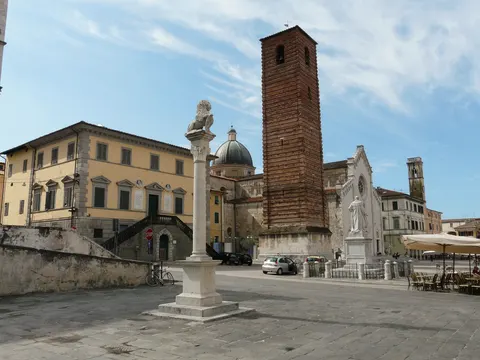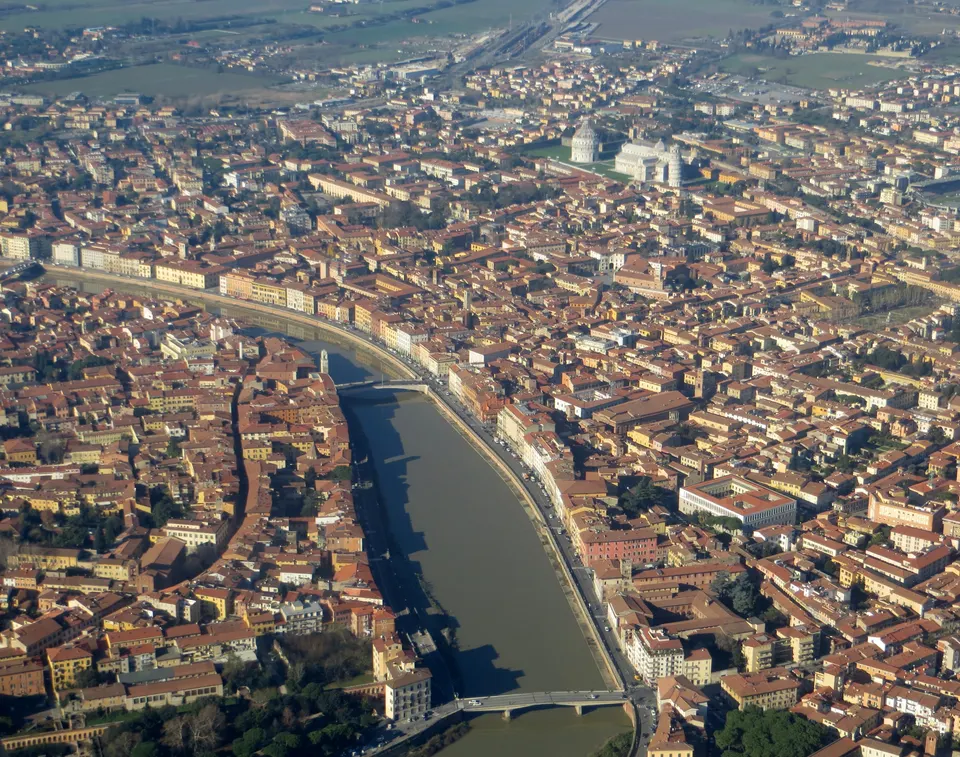

Pisa straddles the Arno just before the river empties into the Ligurian Sea, on Tuscany's central coast. It is the capital of its province, and although the Leaning Tower draws most attention, the city holds more than twenty other historic churches and many medieval and Renaissance palaces. Its architecture was financed by its past as one of the Italian maritime republics, and its university has a history that goes back to the 12th century.
With about 110,000 inhabitants, Pisa lies in Tuscany, Italy, and is a rail hub.
Why go to Pisa?
Pisa's cathedral complex, the Piazza del Duomo, is the most famous part of the city. The bell tower of the cathedral is the leaning tower, and beside it stand the Duomo, the Baptistry and the Campo Santo, a monumental cemetery. The medieval walls around the square are kept by the municipality, and the old hospital now houses the Museo delle Sinopie. Along the Lungarno, the avenues beside the Arno, palaces face each other across the water. The Palazzo Reale was where Galileo showed the planets he had discovered through his telescope to the Grand Duke of Tuscany. The Cantiere delle Navi, a museum in the old Medicean Arsenals, displays ancient ships and ceramics.
When is the best time to visit Pisa?
Average highs range from 10 °C in January to 28 °C in July and August. For city breaks, any month of the year works.
How do I get to Pisa without flying?
Direct bus or train services link Pisa with 10 destinations. Allowing for changes, 1,724 destinations are no more than 14 hours away without flying. Siena is 2h 15m away by bus with FlixBus-eu, with about 2.3 kg of CO₂ per person. The bus from Rome with FlixBus-eu takes 4h 35m; that is about 7.1 kg of CO₂ per person, 88% less than the 60 kg of a flight. From Florence, it takes 53 min by train with TRENITALIA S.p.A., with about 0.9 kg of CO₂ per person.
What to do in Pisa
Leaning Tower of Pisa
The bell tower of the cathedral in the Piazza del Duomo, and the most recognised image of the city.
Santo Stefano dei Cavalieri
A church on the Piazza dei Cavalieri, designed by Vasari, holding a bust by Donatello and spoils from naval battles with the Turks.
Palazzo Reale
A palace on the Lungarno, now a museum, where Galileo demonstrated the planets through his telescope.
Cantiere delle Navi di Pisa
An archaeological area in the old Medicean Arsenals, with ancient ships and ceramics recovered from excavations.