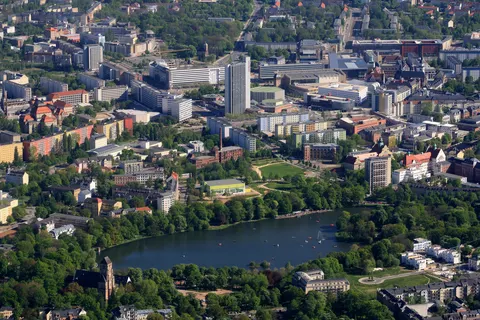
Zwickau is the fourth-largest city in Saxony, with around 88,000 inhabitants, set in the valley of the Zwickau Mulde River. It lies in a row of towns across the densely populated foothills of the Ore Mountains, between Plauen and Dresden. The city is the seat of the Zwickau District, the most densely populated district in the new German states, and it is also home to a university of applied sciences with several campuses.
Zwickau is in Saxony, Germany, and has a population of about 99,000; it is also a rail hub.
Why go to Zwickau?
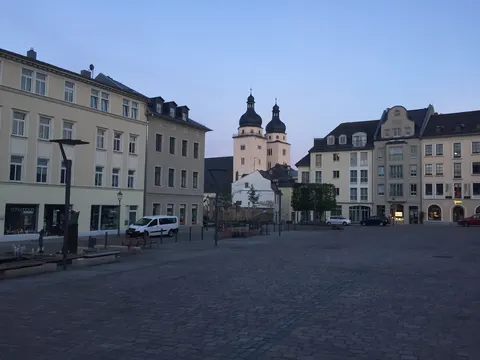
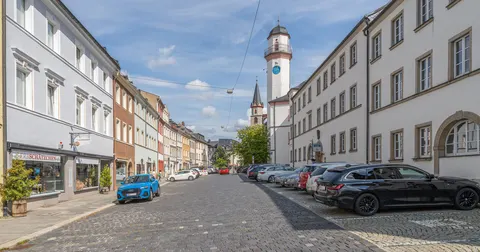
Zwickau is the cradle of Audi and its forerunner Horch, and that industrial story is told at the August Horch Museum. The old town is built around churches from the late Middle Ages, when silver mining in the nearby Erzgebirge made the city rich. St. Mary's Church has an altar with wood carvings and paintings by Michael Wohlgemuth, while St. Catharine's Church is remembered for the reformer Thomas Müntzer, who once preached there. The composer Robert Schumann was born in the marketplace, and his birthplace is now a museum. The late Gothic Gewandhaus, once a cloth merchants' hall, now houses a theatre, and the Zwickau Mulde winds through the city beneath many bridges.
When is the best time to visit Zwickau?
July is the warmest, with highs of about 23 °C, and January is the coolest, at about 2 °C.
How do I get to Zwickau without flying?
From 4 destinations you can travel to Zwickau directly by bus or train. Counting connections, 2,292 destinations can reach it within 14 hours without flying. Travelling from Leipzig, allow 1h 02m by train with DB Regio AG Südost; that is about 1.2 kg of CO₂ per person. From Chemnitz, it takes 31 min by train with Mitteldeutsche Regiobahn, with about 0.6 kg of CO₂ per person. The bus from Nuremberg with FlixBus-eu takes 2h 35m; that is about 4.7 kg of CO₂ per person, 88% less than the 40 kg of a flight.
What to do in Zwickau
St. Mary's Church (Marienkirche)
A Gothic church with a tall spire and a large bell, holding an altar with wood carvings and a carved pietà by Peter Breuer.
St. Catharine's Church
A late Gothic church with an altar piece linked to Lucas Cranach the Elder, and a past as the pulpit of Thomas Müntzer.
Robert Schumann House
The house in the marketplace where the composer was born, now a museum dedicated to his life and work.
August Horch Museum
The museum that traces the histories of the Audi and Horch car factories, which began in Zwickau.