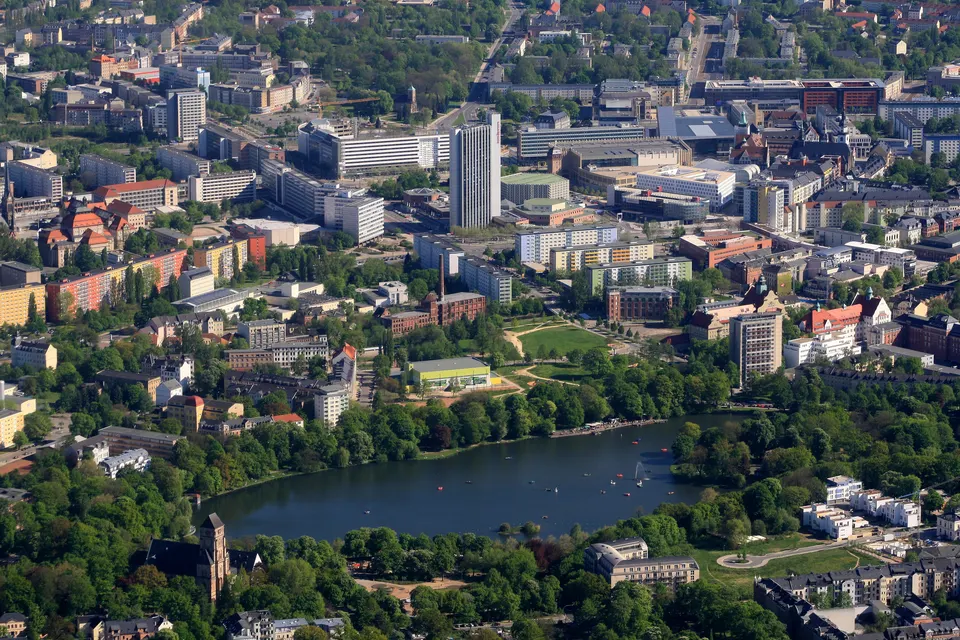

Chemnitz, known as Karl-Marx-Stadt during the East German era, is one of the largest cities in Saxony, after Leipzig and Dresden. It lies in the Ore Mountain Basin, with the Ore Mountains to the south and the Central Saxon Hill Country to the north. The city is known for its many industrial age buildings, and it was European Capital of Culture in 2025.
Chemnitz, in Saxony, Germany, is home to about 247,000 people and works as a rail hub.
Why go to Chemnitz?
The Kassberg neighbourhood keeps its 18th and 19th century buildings, and the Karl Marx Monument, by Lev Kerbel, is a landmark nicknamed Nischel by locals. The Old Town Hall has a Renaissance portal, and the red tower from the old city wall is the most conspicuous landmark. Chemnitz's industrial heritage shows in the Chemnitz Industrial Museum and in the State Museum of Archaeology, housed in the former Schocken department store by Erich Mendelsohn. The Villa Esche, an art nouveau house by Henry van de Velde, sits near the city centre.
When is the best time to visit Chemnitz?
In July and August the average high reaches 22 °C; in January it is closer to 2 °C. For city breaks, go in May, June and September.
How do I get to Chemnitz without flying?
Chemnitz has direct bus or train links to 12 destinations. Within 14 hours, travellers from 2,261 destinations can get here without flying. The train from Leipzig with Mitteldeutsche Regiobahn takes 1h 02m; that is about 1.2 kg of CO₂ per person. Dresden is 56 min away by bus with FlixBus-eu, with about 1.7 kg of CO₂ per person. Travelling from Erfurt, allow 1h 55m by bus with FlixBus-eu; that is about 3.6 kg of CO₂ per person.
What to do in Chemnitz
Karl Marx Monument
A monument by Lev Kerbel, nicknamed Nischel, a Saxon dialect word for head, by the locals.
Kassberg
A neighbourhood of 18th and 19th century buildings, with the Kassberg area as one of the city's most visited historic quarters.
Villa Esche
An art nouveau house built in 1902 by Henry van de Velde, now a museum dedicated to his work.
Museum Gunzenhauser
A modern art museum in a former bank, showing the collection of Alfred Gunzenhauser, with works by Otto Dix and Karl Schmidt-Rottluff.