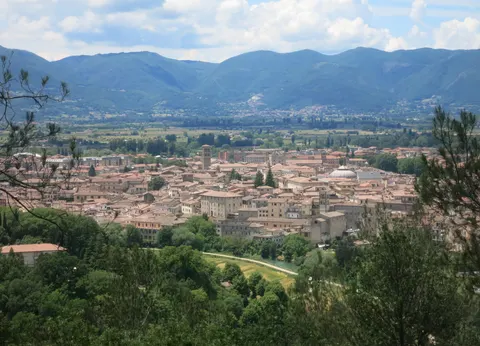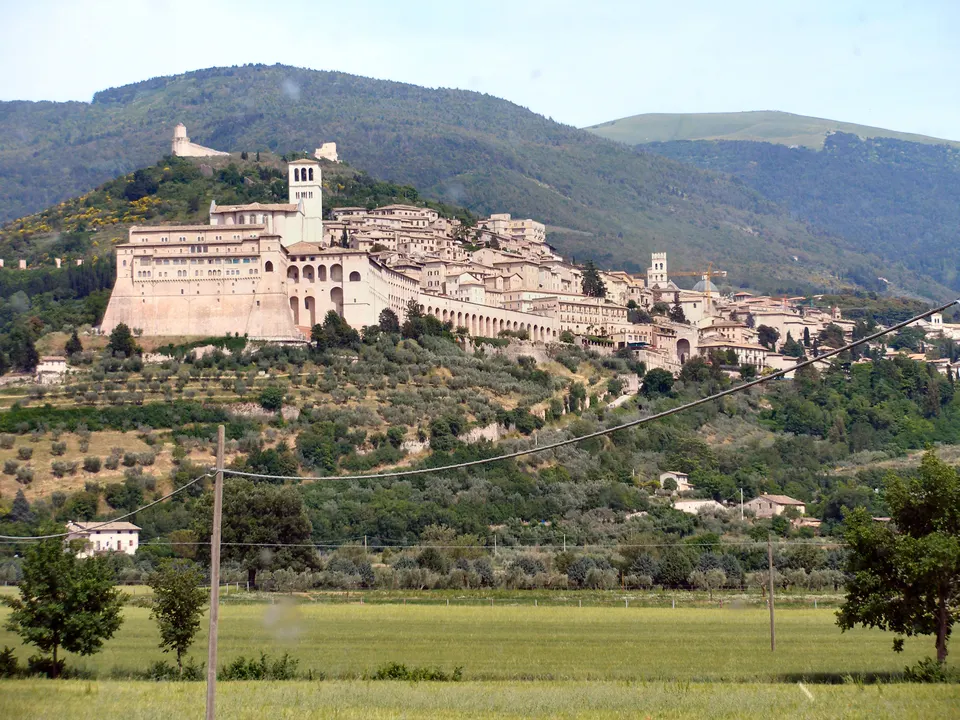

Assisi is a town in the Province of Perugia in the Umbria region of Italy, on the western flank of Monte Subasio. It is the birthplace of St. Francis, who founded the Order of Friars Minor in the town, and of St. Clare, who founded the Order of Poor Ladies with him. The Latin poet Propertius is generally regarded as having been born here as well.
Assisi is in Umbria, Italy, and has a population of about 3,732.
Why go to Assisi?
Assisi's main sights cluster around the hilltop and the central square. The Rocca Maggiore, the imperial fortress above the town, was extensively rebuilt by Cardinal Albornoz and later enlarged by popes. The Piazza del Comune holds the Temple of Minerva, a well-preserved Roman temple, along with the Palazzo dei Priori and the Torre del Popolo. The Church of San Pietro has three rose windows on its façade. In early May the Calendimaggio festival re-enacts medieval life, with the upper and lower parts of town competing in processions, dancing and flag-waving. Assisi embroidery, counted-thread work practised here since the 13th century, is another local craft.
When is the best time to visit Assisi?
July and August are the warmest, with highs of about 28 °C, and January and December are the coolest, at about 8 °C.
How do I get to Assisi without flying?
From 3 destinations you can travel to Assisi directly by train. Counting connections, 1,279 destinations can reach it within 14 hours without flying. Travelling from Rome, allow 2h 06m by train with Trenitalia; that is about 1.6 kg of CO₂ per person. From Perugia, it takes 24 min by train with Trenitalia, with about 0.2 kg of CO₂ per person. The train from Foligno with Trenitalia takes 18 min; that is about 0.2 kg of CO₂ per person.
What to do in Assisi
Rocca Maggiore
The larger of the town's two castles, on the hill above it, extensively rebuilt by Cardinal Albornoz.
Temple of Minerva
A well-preserved Roman temple facing the Piazza del Comune, now transformed into the Church of Santa Maria sopra Minerva.
Santa Maria Maggiore
The earliest extant church in Assisi, formerly the cathedral of the city.
Roman amphitheatre
Built in the early 1st century AD, its elliptical plan is still visible through the medieval houses built around it.