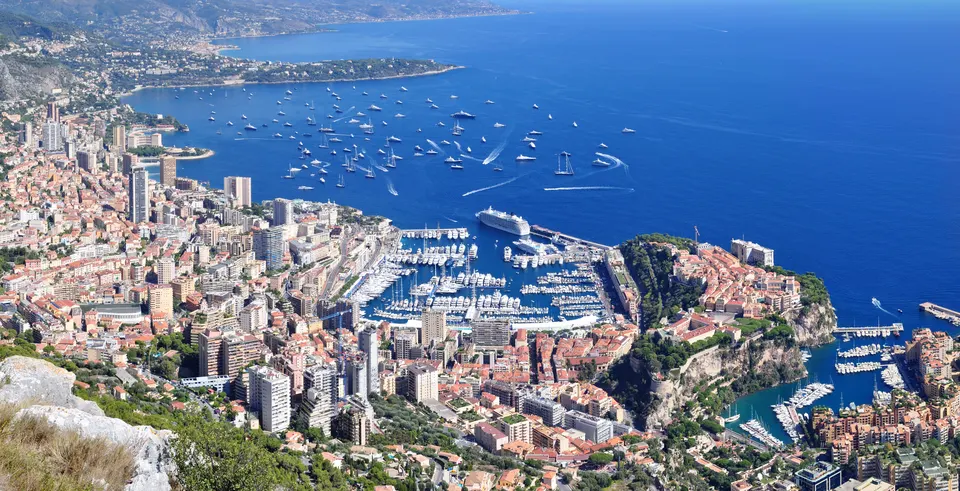

Monaco is a sovereign city-state on the French Riviera, bordered by France on three sides, with the Mediterranean to the south. It is the second-smallest sovereign state in the world after Vatican City, and the most densely populated. Its mild climate, scenery and gambling facilities made it a destination for the wealthy. The House of Grimaldi has ruled it, with brief interruptions, since 1297.
With about 33,000 inhabitants, Monaco lies in Municipality of Monaco, Monaco, and is a rail hub.
Why go to Monaco?
Monaco's signature style is the Belle Époque of Monte Carlo, and its finest expression is the Casino with the Salle Garnier, designed by Charles Garnier and Jules Dutrou. The Oceanographic Museum is one of the principality's best-known sights, and Monaco is a centre of marine conservation and research, home to a UN marine laboratory. Motor sport gives Monaco its best-known event, the Monaco Grand Prix, one of the original Formula One Grands Prix. The Monte Carlo Rally takes its name from the local motorsports association. Museums also include the Napoleon Museum, the Museum of Stamps and Coins and the Monaco Top Cars Collection. The Grotte de l'Observatoire, a cave open to the public since 1946, is another draw.
When is the best time to visit Monaco?
Average highs range from 11 °C in January and February to 25 °C in July and August. June, July and August are the time for beach holidays. For city breaks, any month of the year works.
How do I get to Monaco without flying?
Direct bus or train services link Monaco with 11 destinations. Allowing for changes, 1,954 destinations are no more than 14 hours away without flying. Sanremo is 1h 00m away by train with Trenitalia, with about 0.3 kg of CO₂ per person. The train from Nice with SNCF Voyageurs SA takes 17 min; that is about 0.1 kg of CO₂ per person. From Menton, it takes 12 min by train with SNCF, with about 0.1 kg of CO₂ per person.
What to do in Monaco
Monte Carlo Casino
The first state casino, opened in the late 19th century, and the most florid expression of Monaco's Belle Époque style.
Oceanographic Museum
A museum of the sea, part of a principality that is a centre of marine conservation and research.
Grotte de l'Observatoire
A limestone cave in the bedrock beneath the principality, open to the public since 1946.