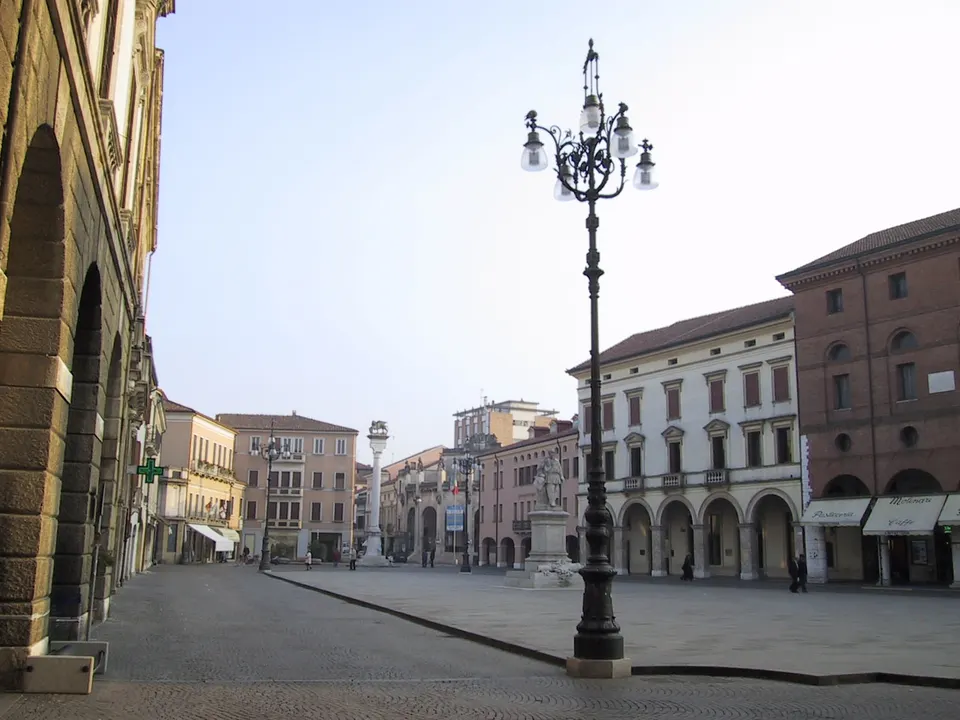

Rovigo is a city and the capital of its province in the Veneto region of northeast Italy. It stands on the Polesine, the low ground between the Adige and Po rivers and the sea, and it lies on the Adigetto Canal. The architecture of the town bears the stamp of both Venetian and Ferrarese influence, and its historic centre holds churches, palaces and a gallery of paintings.
Rovigo is in Veneto, Italy, and has a population of about 50,000.
Why go to Rovigo?
The best-known building is the Madonna del Soccorso, called La Rotonda. It was built between 1594 and 1606 by Francesco Zamberlan, a pupil of Palladio, to house a miraculous image of the Madonna and Child. The church has an octagonal plan and a surrounding portico, and its walls are covered in paintings by provincial and Venetian artists. The Pinacoteca dei Concordi holds works including a Madonna and Child by Giovanni Bellini and a Flagellation of Christ by Palma the Elder. The Palazzo Roverella, a Renaissance palace, now serves as the town art gallery, and the town hall keeps a library with rare early editions.
When is the best time to visit Rovigo?
July is the warmest, with highs of about 30 °C, and January and December are the coolest, at about 8 °C.
How do I get to Rovigo without flying?
There are no direct train, bus or ferry links to Rovigo yet. You can still search the trip planner for a route with changes.
What to do in Rovigo
Rovigo Cathedral
The Duomo, dedicated to the martyr Pope Stephen I, with a Resurrection of Christ by Palma the Younger inside.
Madonna del Soccorso
Known as La Rotonda, an octagonal church with a campanile by Baldassarre Longhena and walls covered in paintings by Venetian and provincial artists.
Pinacoteca dei Concordi
The Concordi Gallery holds paintings by Bellini, Palma the Elder and Jan Gossaert, and portraits by Tiepolo and Alessandro Longhi.
Torre Donà
A brick tower standing 66 metres high, a remnant of a castle from the period of Este rule over the town.