
Ferrara is a city in Emilia-Romagna in northern Italy, capital of its province and about 44 km north-east of Bologna. It sits on the Po di Volano, a branch of the Po River, on a flat plain. The town has broad streets and many Renaissance palaces from the time it hosted the court of the House of Este, and UNESCO has designated it a World Heritage Site.
With about 132,000 inhabitants, Ferrara lies in Emilia-Romagna, Italy, and is a rail hub.
Why go to Ferrara?
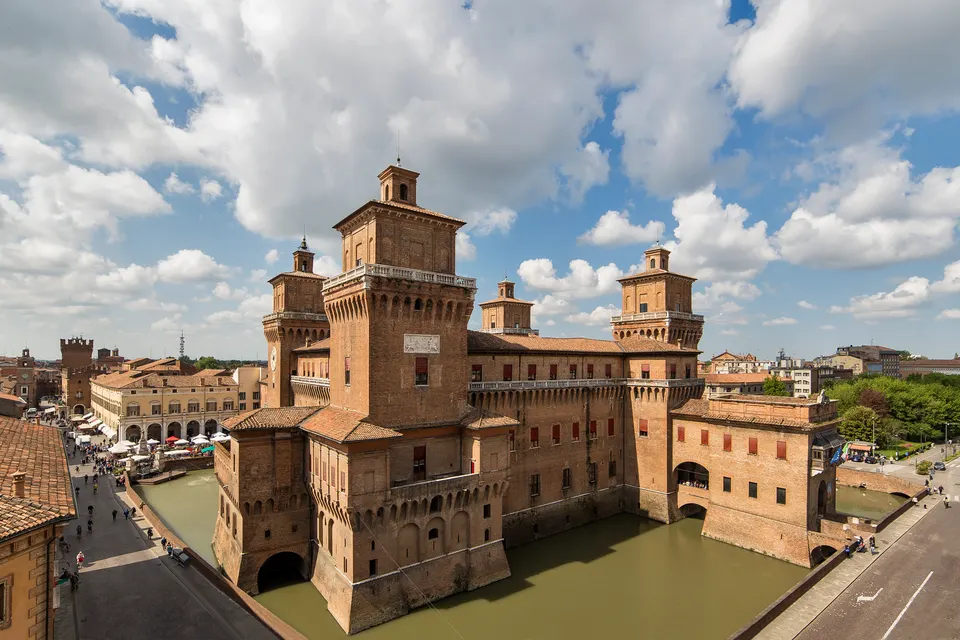
Ferrara is a Renaissance town at heart. Its Este Castle, a fortified residence built in the 14th century, sits in the very centre of town. The Cathedral of Saint George mixes Romanesque, Gothic and Renaissance elements in one façade. The Palazzo Schifanoia has frescoes of the life of Borso d'Este, the signs of the zodiac and the months, and the Palazzo dei Diamanti houses the National Picture Gallery with the School of Ferrara. The southern district is the oldest, with narrow alleys from the Early Middle Ages. Casa Romei, a merchant's house, keeps much of its original decoration.
When is the best time to visit Ferrara?
Average highs range from 8 °C in January and December to 31 °C in July. For city breaks, any month of the year works.
How do I get to Ferrara without flying?
Direct bus or train services link Ferrara with 3 destinations. Allowing for changes, 2,104 destinations are no more than 14 hours away without flying. Bologna is 30 min away by train with Trenitalia, with about 1 kg of CO₂ per person. The bus from Verona with FlixBus-eu takes 1h 25m; that is about 2.2 kg of CO₂ per person. From Padua, it takes 30 min by train with Trenitalia, with about 1 kg of CO₂ per person.
What to do in Ferrara
Este Castle
A moated fortress in the centre of town, built for the Este family and renovated in the 15th and 16th centuries.
Cathedral of Saint George
Designed by Wiligelmus and consecrated in 1135, its façade blends Romanesque, Gothic and Renaissance styles.
Palazzo Schifanoia
A palace built for Albert V d'Este, with frescoes of Borso d'Este's life, the zodiac signs and the months.
Palazzo dei Diamanti
Named after its diamond-cut stone façade, and home to the National Picture Gallery and its school of Ferrara paintings.