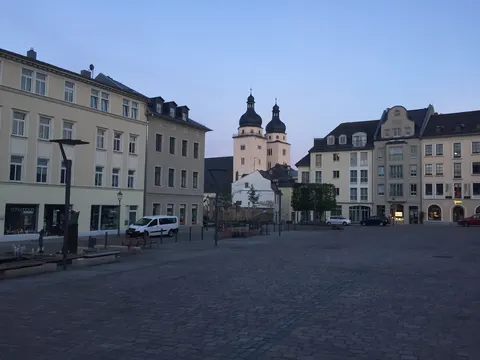
Jena is a city in Thuringia, Germany, with about 110,000 inhabitants. It is a centre of education and research, and the University of Jena, founded in 1558, is one of its major institutions. Its leading industry is precision optics, and the city lies in a hilly landscape within the wide valley of the Saale river. It is also a service hub for the surrounding region.
Jena is in Thuringia, Germany, and has a population of about 105,000; it is also a rail hub.
Why go to Jena?
Jena is known as a city of science and optics. Carl Zeiss, Schott and Jenoptik grew out of its optical industry, which led the local economy for most of the 20th century, and the Optical Museum at Carl-Zeiß-Platz traces that history. The Romantic era left its mark too, with figures such as Schiller, Hegel and Novalis linked to the town. The Botanic Garden was established in 1794 and holds plants from around the world. The wild orchids of the hills and the nature reserves, partly maintained by volunteers, make the countryside around the city as notable as its streets. It is also a centre of research institutes.
When is the best time to visit Jena?
July and August are the warmest, with highs of about 23 °C, and January is the coolest, at about 3 °C. City breaks work best in May, June and September.
How do I get to Jena without flying?
From 11 destinations you can travel to Jena directly by bus or train. Counting connections, 2,423 destinations can reach it within 14 hours without flying. Travelling from Berlin, allow 3h 41m by bus with FlixBus-eu; that is about 5.9 kg of CO₂ per person, 88% less than the 50 kg of a flight. From Leipzig, it takes 1h 15m by bus with FlixBus-eu, with about 1.9 kg of CO₂ per person. The bus from Frankfurt with FlixBus-eu takes 3h 35m; that is about 6.1 kg of CO₂ per person, 88% less than the 52 kg of a flight.
What to do in Jena
Optical Museum Jena
Shows the history of optical instruments such as glasses, microscopes, cameras and telescopes.
Botanic Garden
One of the oldest botanic gardens in Germany, established in 1794, with 12,000 plants from around the world.
Schiller's garden house
The former summer house of Friedrich Schiller at Schillergässchen, with an exhibition on his life and his link to Jena.
Town hall on the Markt square
A Gothic town hall with an astronomical clock featuring the figure Schnapphans.